
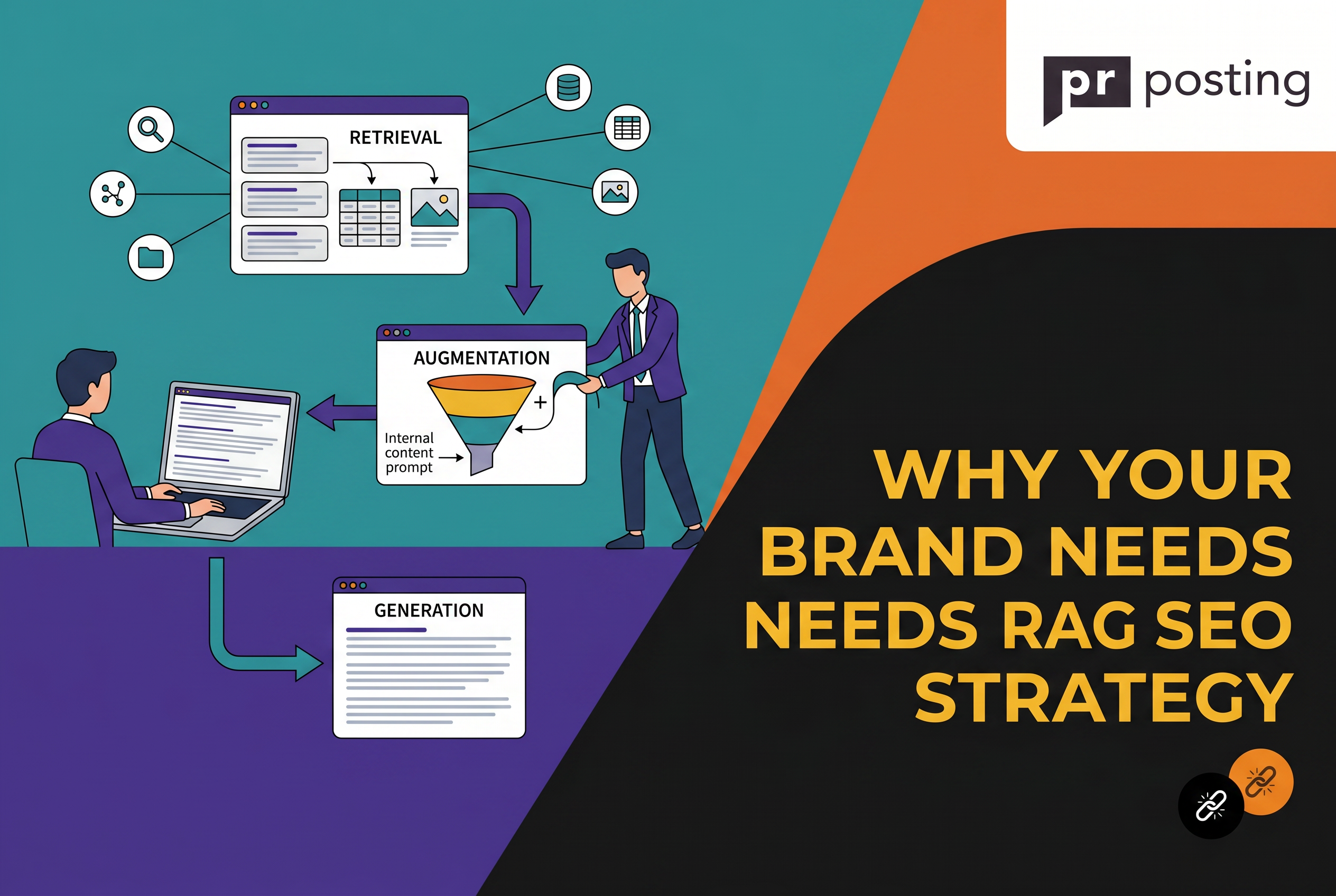
Why Your Brand Needs a RAG SEO Strategy
This strategy aims to become the primary source of information for synthesized AI answers. High information density and semantic clarity are essential for success.
By optimizing content for retrieval-augmented generation (RAG), you move from chasing clicks to becoming a trusted source of AI-generated answers.
Key Takeaways
- RAG acts as a link between your website and the main AI processor.
- Information gain is now the primary ranking factor.
- Source attribution creates long-term trust and visibility.
- AI engines prioritize verifiable, original data over generic summaries.
What is RAG in SEO and Marketing?
What is RAG in SEO?
It is an architectural framework that lets AI models query external data before generating a response.
This process ensures the AI provides fresh, accurate information rather than relying on its static training weights.
In marketing, this turns your website into a live library for AI engines like Gemini and SearchGPT.
Standard Large Language Models possess knowledge cutoffs and static data.
Rag SEO allows your brand to bypass these limits. Every new study or product update you publish becomes immediately retrievable.
This approach ensures your brand serves as the authoritative voice in generative answers. Without it, AI models might hallucinate or ignore your data.
How Does RAG Improve Content Marketing and SEO?
It shifts the focus from simple keyword matching to high-utility information gain.
AI systems retrieve your content based on vector similarity rather than specific phrases. This means digital marketers must produce original, unique data that offers a utility surplus compared to existing search results.
Artificial intelligence strives to obtain new information. AI overviews contain links to materials that provide unique, verifiable facts.
High-quality content now acts as a retrieval asset. If you provide the best table or the most recent statistics, AI cites you.
- Live Data. RAG pulls real-time facts from your website.
- Accuracy. Grounded answers reduce the risk of brand misinformation.
- Citation Share. You gain visibility within the AI-generated answers.
Search Engine Optimization vs. RAG Optimization
What does RAG mean in the context of search?
Traditional SEO works on a “link list” logic. RAG optimization uses “semantic synthesis” to create a narrative.
One rewards volume. The other rewards precision.
SEO vs. RAG comparison table
| Feature | Traditional Search (SEO) | RAG-Powered Search |
| Logic | Keyword matching and Backlinks | Semantic similarity and Vector math |
| Output | List of URLs (Blue Links) | Synthesized Answer and Citations |
| Goal | High Click-Through Rate (CTR) | High Information Gain and Citation |
Gartner forecasts that search volume will decline by 25% by 2026 due to AI. This makes RAG optimization the only way to capture AI engines’ attention.
You must structure content for extraction. Use short sentences. Place answers first.
Multimodal Search Optimization through RAG
Rag optimization fixes the tendency for AI to invent false details about products.
When you structure content for retrieval, AI pulls from your verified technical specifications.
This process links the generative response to your actual documentation. Validated data serves as a kind of safety net for the model.
Grounding is the primary defense against brand misinformation in 2026. By providing a clear knowledge base, you control the narrative.
The AI stops guessing. Your verified facts become the script.
- Fact Verification. AI compares its internal weights against your live data.
- Brand Safety. Direct retrieval prevents the AI from attributing competitor features to your products.
- Data Integrity. Structured tables ensure numerical precision in generated overviews.
Enhancing E-E-A-T Through RAG Optimization
Rag optimization boosts E-E-A-T by providing clear evidence blocks that AI systems use to justify their answers.
Structured, factual data signals expertise and authoritativeness to retrieval algorithms. AI agents prefer sources that offer verifiable proof over vague marketing claims.
Trust is a mechanical calculation for AI. Providing citable evidence makes your brand the path of least resistance for the model.
It needs a source to cite. You provide the best one.
- Experience. Use first-hand data and unique case studies.
- Expertise. Deepen your content with niche technical attributes.
- Authoritativeness. Link your facts to a centralized knowledge graph.
- Trustworthiness. Use RAG SEO to maintain a 100% accuracy rate in citations.
Retrieved context improves AI answers by fixing the common flaws in LLMs like hallucinations, outdated data, or missing niche knowledge.
If your site isn’t “retrieval-ready,” AI engines will simply ignore your content.
The 7 Types of RAG Architectures for SEO
RAG SEO refers to optimizing website data so that Large Language Models can accurately retrieve and cite your content.
This process bridges the gap between static web pages and the generative answers seen in AI Overviews.
- RAG optimization ensures your brand remains a primary data source for AI.
- Moving beyond Vanilla RAG prevents your content from being ignored by AI filters.
- Knowledge Graphs are essential for maintaining entity relationships in search.
Vanilla (Standard) RAG: The Basic Search and Paste
Vanilla RAG is the most common way an AI “reads” your site. The system searches for keywords, grabs a text chunk, and summarizes it for the user.
What does RAG mean in search when it is “vanilla”?
It means the AI performs a simple one-step lookup. It lacks a deep understanding of your brand’s unique value.
- Fastest to implement for small sites.
- Relies heavily on basic keyword matching.
- Can lead to hallucinations if the text is vague.
On Reddit, users often complain that basic RAG misses the nuance of technical guides.
This happens because the AI stops at the first relevant paragraph. It doesn’t look deeper. You must use clear headers to help this simple scout find the right treasure.
Advanced RAG SEO: Re-ranking for Quality
Advanced RAG adds a “Re-ranking” step to filter out low-quality noise.
The AI finds ten possible answers but uses a second model to pick the most authoritative one.
RAG optimization at this level requires high E-A-E-T signals. The re-ranker looks for experts.
- Initial retrieval pulls broad matches.
- The Re-ranker scores them based on relevance.
- The top three results form the final AI answer.
Ahrefs notes that 76 % of AI Overviews cite at least one of the top 10 organic results.
This confirms that being “relevant” isn’t enough anymore. You must be the best. Short sentences help. Direct claims help more.
GraphRAG: Mapping Industry Relationships
GraphRAG uses Knowledge Graphs to understand how your brand connects to broader topics.
It doesn’t just look for words. It looks for the “nodes” and “edges” of your expertise.
How does RAG improve content marketing and SEO? It proves your authority by linking concepts.
- Connects “Your Product” to “User Problem.”
- Reduces the chance of your brand being swapped for a competitor.
Think of your site as a map. GraphRAG follows the roads. If your internal linking is broken, the AI gets lost. Use JSON-LD to tell the AI exactly who you are.
How to Implement RAG SEO Effectively
RAG SEO is the strategic process of preparing website data for retrieval by artificial intelligence models.
Success requires high fact density, structured schema, and citable “atomic” content blocks.
These elements ensure LLMs find and credit your brand during generative search sessions.
- JSON-LD defines your brand entity for AI models.
- “Atomic” answers improve the precision of AI “chunks.”
- Information gain provides unique data that AI cannot find elsewhere.
- llms.txt acts as a map for modern AI crawlers.
Step-by-Step RAG Optimization Process
RAG optimization involves refining your technical site architecture to assist AI scouts.
You must move from broad topics to specific, verifiable data points. This transition ensures that AI systems select your content over generic competitors.
Create “Atomic” Content Blocks
Write texts in 50-100-word chunks. Artificial intelligence can easily “break” them into groups. Avoid long, wordy introductions. Get straight to the point.
What is RAG in SEO? It is the bridge between your database and an AI’s response.
Optimize for Information Gain
Do not repeat Wikipedia. Provide original case studies. Add current pricing or rare statistics.
According to iPullRank, unique data is the best way to earn AI citations.
Deploy llms.txt
This file is a machine-readable directory. It tells bots which pages are the most citable. It saves crawl budget. It focuses the AI on your highest-quality content.
Checklist for RAG Optimization Success
Effective RAG optimization requires a balance of technical signals and high-quality information.
Use this checklist to audit your pages for AI readiness. This structure helps AI determine the reliability of your data.
- Fact Density. Include 3+ verifiable facts in the first 200 words.
- Schema Markup. Implement Product, FAQ, and Organization schemas.
- Crawlability. Ensure GPTBot and OAI-Search can access your site.
- Semantic Clarity. Use H2 and H3 headers as clear questions.
Clear formatting often leads to more citations. High information density wins.
Avoid These Common RAG SEO Mistakes
RAG SEO errors typically arise from data hiding or using unnecessary information. AI models ignore content that lacks substance.
If AI can’t process the data, it will skip your site entirely.
- Thin Content. AI won’t retrieve “fluff.” It needs raw data.
- Gated Knowledge. Data behind a PDF or login is invisible.
- Complex Formatting. Decorative layouts confuse headless AI crawlers.
| Mistake | Impact on AI | Fix |
| Vague Pronouns | Lowers retrieval accuracy. | Use specific nouns. |
| No Schema | AI guesses your identity. | Use JSON-LD. |
| PDF Only Data | Often ignored by RAG. | Use HTML text. |
These factors are the main obstacles for RAG search engines.
If you rely too heavily on pronouns like “it” or “they,” you leave the AI guessing. The system can’t build an accurate mathematical map of what you’re actually saying.
Everything becomes confusing. Data without a clear schema creates a similar problem. The search engine has to work twice as hard to verify your claims.
Often, it simply gives up, skipping your content entirely in favor of a more readable source.
FAQs
What is a RAG in marketing?
It is a strategy that treats your marketing collateral as a searchable knowledge base for AI. This ensures your brand values and data are used correctly in AI chats.
Is ChatGPT a RAG?
No. ChatGPT is an LLM. However, it uses RAG when it browses the web to find your latest blog posts or data.
What are the 7 types of RAG?
The types include Basic, Naive, Modular, and Advanced RAG. Each varies in how it retrieves and reranks data for the AI.
What does RAG mean in search?
It means the search engine uses a retrieval step to find specific facts before generating a response. This increases the accuracy of the final answer.
What is RAG in SEO for technical sites?
It is the practice of using JSON-LD and semantic headers to make your technical specs easily extractable for AI bots.