
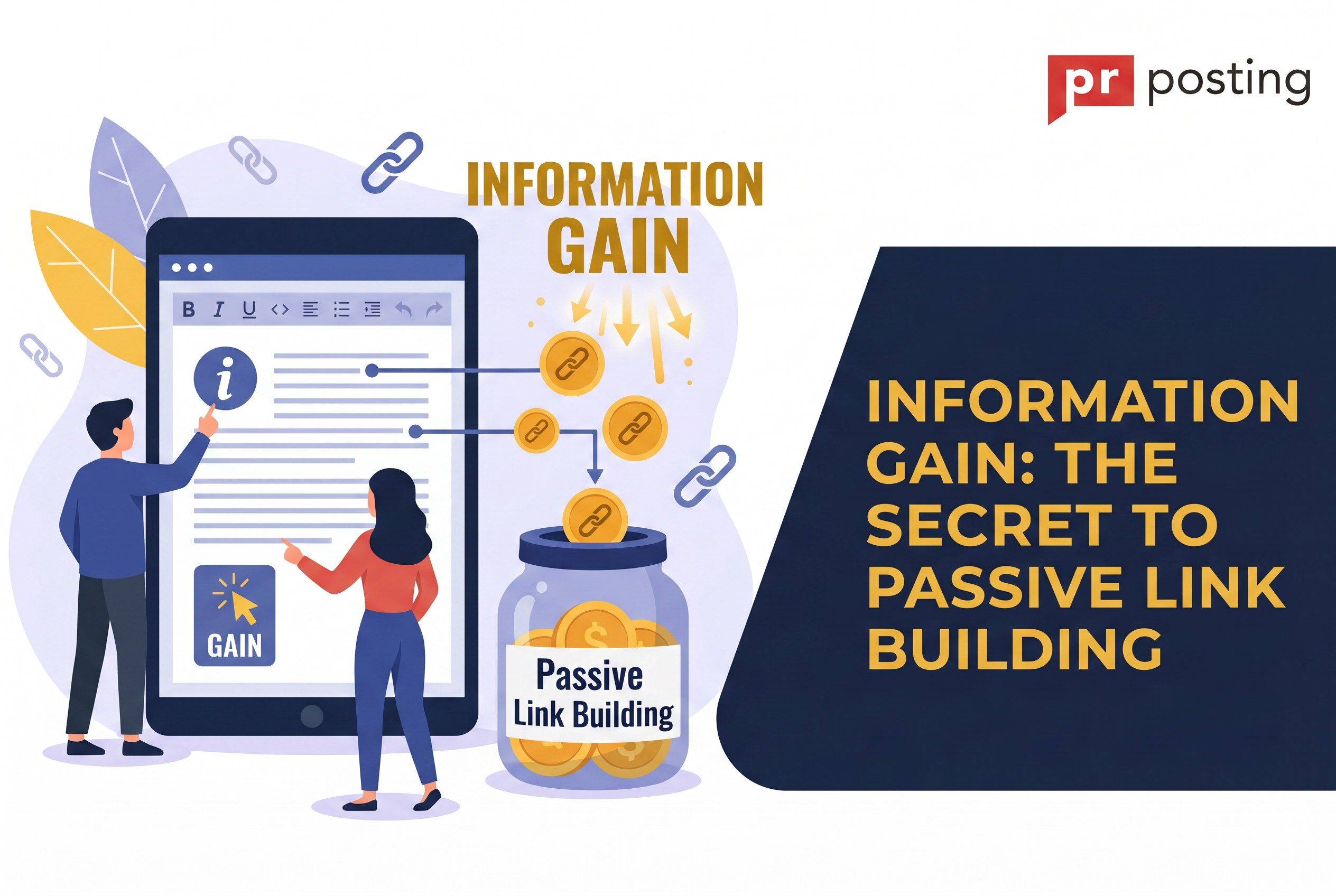
Information Gain: The Secret to Passive Link Building
High scores indicate that your content contains fresh data or new perspectives. This utility forces AI models to list your site as the primary source.
This way, you can get authoritative links without resorting to manual mailing or spam methods.
Key Takeaways
- Include one fact not found in the top 3 Google results.
- Format unique data in “searchable” blocks for AI agents.
- Signal “Original Research” clearly within your metadata.
- Use Schema.org claimedRole or evidenceLevel tags for authority.
What is Information Gain in SEO?
Information gain rate is the mathematical delta between a model’s training baseline and new data.
It measures how much “excess usefulness” your content adds to the existing knowledge graph.
Higher rates signal to LLMs that your page contains exclusive knowledge. This makes your site a necessary citation for grounding generative answers accurately.
| Metric | Purpose | Ideal State |
| Information Gain Rate | Measures newness against known data | High |
| Entity Density | Tracks specific concepts per paragraph | Focused |
| Fact Density | Counts verifiable claims vs word count | High |
Why Information Gain Rate Matters for Link Building
Search engines now penalize redundant content to stop AI “slop” from clogging the index.
If your article provides a proprietary framework or a new survey, you have high information gain.
This makes your page a vital resource for any AI agent. AI engines must cite your URL to remain factual and grounded.
Link building is no longer about asking for attention. It is about being the source of truth.
When you provide a unique case study, you create a citable asset. Other writers find your data through AI Overviews. They link to you to back up their own claims.
According to a study by Backlinko, citable data remains the top driver for organic backlinks.
High information gain ensures you stay at the top of that food chain. It is a simple concept. Be original or be invisible.
Why do traditional link-building methods fail now?
The Skyscraper technique relied on merging the top 10 results into one massive guide. This strategy creates zero information gain because it adds no new facts.
Today, this approach causes pages to be filtered out of AI Overviews. LLMs view these guides as redundant echoes of better sources.
- They lack a unique missing entity or data point.
- Search engines prioritize the original source over the aggregator.
- Nowadays, the word count does not equal authority.
- Redundant content triggers low utility filters in 2026 algorithms.
Stop trying to be better by writing longer articles. Start being different.
If artificial intelligence can summarize your article without discovering a single new fact, your work is useless. You must break the stereotypes.
Best Tools for Measuring Information Gain
To dominate search results in 2026, you must verify your content’s uniqueness.
Tracking your uniqueness score involves auditing your page against the top 10 ranking cluster.
Use specific, specialized tools to identify exactly where your content adds new, non-redundant value.
This process ensures your information gain rate exceeds the “Information Gate” threshold required for AI citations.
Strategic AI and Content Performance Indicators
| Tool Category | Tool / Method | Metric to Watch | Description |
| Semantic Analysis | MarketMuse / Clearscope | Content Gap Velocity | Measures how quickly your domain closes “authority gaps” compared to rising competitors in specific topic clusters. |
| LLM Testing | Custom GPT Benchmarking | “Did I tell you something new?” Prompt | A “self-aware” evaluation metric where an LLM judges if a generated response provides unique value beyond its base training data. |
| Plagiarism+ | Copyleaks | Cross-Reference Originality Score | Moves beyond simple string-matching to identify “semantic plagiarism” or AI-paraphrased content across multiple source databases. |
| Data Extraction | Diffbot | Entity Density vs. Competitors | Calculates the ratio of unique, structured “entities” (people, companies, facts) extracted from your data versus a competitor’s knowledge graph. |
Why These Metrics Matter
- Content Gap Velocity. It’s no longer enough to just have a high content score. You need to fill topical gaps faster than the Search Engine Results Pages evolve.
- The “Newness” Prompt. By asking the model, “On a scale of 1-10, does this response contain information not found in your standard pre-training?” you can filter out generic text and ensure your outputs are actually insightful.
- Entity Density. This metric tells you if your content is fluff or fact-dense. High entity density usually correlates with better performance in RAG (Retrieval-Augmented Generation) systems.
Successful SEOs use these metrics to avoid repetitive summaries.
How to Analyze Content for Information Gain
High information gain requires a structured, data-first approach to writing. You must move beyond the skyscraper method.
Start by analyzing what the current search landscape already knows. Then, add data that does not exist elsewhere. This creates a “primary source” block that AI agents find irresistible.
Step-by-Step Guide to High Information Gain Rate Content
- Baseline the SERP. Use an LLM to summarize the top 5 results. Identify their shared facts. This is your redundancy baseline.
- Identify the missing entity. Find a specific data point or perspective that those top results ignore. Look for gaps in their logic.
- Add Primary Data. Include internal company data, survey results, or expert interviews. This establishes you as an authority.
- Structure for RAG. Use H2 and H3 headings. Clearly state the new information. This will help search engines index the differences between your data and data from other sources.
According to Dr. Jackson at the Data Science Institute, University of Chicago, AI models prioritize information with high distinctness.
By following these steps, you’ll create a page that will become a vital source of information. You become the source.
Common Mistakes to Avoid with Information Gain
Low information gain is due to the repetition of facts found in existing search results.
If AI summarizes your text without identifying new information, your information gain is zero.
Many marketers prioritize word count over substance. This strategy fails because LLMs filter out redundant fluff. High fact density identifies your site as an authoritative source.
Why Summarizing Others Drops Rankings
A Google Helpful Content Update shows that duplication leads to lower indexing.
Repeating the first three results is of no use. AI engines have already learned these facts.
They do not need your recap. Focus on adding a missing entity or a fresh perspective.
Fluff Over Fact: The Density Problem
- Word count no longer signals authority.
- High fact density drives AI citations.
- Redundant paragraphs trigger quality filters.
- Concise, data-heavy blocks win featured snippets.
Link Building via Information Gain
Passive link building in 2026 relies on the citable asset framework. You earn backlinks by becoming the primary source of truth for specific data.
Searchers and AI agents do not want opinions. They want evidence. By including original statistics, you force the AI engines to cite your brand.
| Asset Type | Action | Link Building Result |
| Proprietary Statistic | Include original survey data | High-authority news citations |
| Named Framework | Label a new workflow | Industry-wide attribution links |
| Case Study | Share internal win/loss data | Deep contextual backlinks |
Fact Stacking Method
Include a table of original, internal data.
According to research by Ian Kirk, 41 % of marketers who publish original research report significant link growth.
First-party data acts as a natural PR magnet. By providing “surplus value” that AI models can’t replicate, it provides a competitive advantage in both traditional search and generative search optimization (GEO).
The Named Framework
Create a unique name for your process. When others describe this method, they should link to your original publication.
This “named framework” strategy turns a simple blog post into an industry standard.
FAQs
What is Information Gain Rate (IGR)?
IGR is the mathematical “delta” or difference between what an AI model already knows (its training baseline) and the new data your content provides.
If your page contains zero facts that the AI hasn’t seen before, your IGR is zero.
Why is “Fact Density” important?
AI systems prioritize information density over word count. High density suggests your content is efficient and reliable.
How does the “Information Gate” affect me?
If your content lacks sufficient information gain, AI Overviews will ignore your site. You must provide a utility surplus.
Should Information Gain be high or low for SEO?
Higher is always better. A high Information Gain score signals to Google and LLMs that your content is a primary source. High IGR content is prioritized for AI Overviews and featured snippets because it provides the “missing piece” of the puzzle.
How does Information Gain lead to “passive” link building?
In 2026, AI agents (like Gemini or GPT-5) are the primary readers that discover content.
When these models find a unique statistic or framework on your site that doesn’t exist elsewhere, they cite you as the source.
Other creators then find your data through these AI answers and link to you manually, creating a compounding loop of earned citations.
What is the Information Gate in SEO and GEO?
The Information Gate refers to the threshold of uniqueness a piece of content must pass to be included in Generative Engine Optimization (GEO) results.
If your content doesn’t provide enough Information Gain, it is filtered out as redundant.
How can I measure my “Uniqueness Score”?
You can audit your IGR by using a “Contrastive Prompt” with an LLM: “Here are the top 5 results for [Keyword]. Here is my draft. List every fact in my draft that is NOT present in the top 5.” If the list is empty, your IGR is too low.
How do I use Schema.org to boost Information Gain signals?
Use specific tags like claimedRole for original assertions or evidence-based for case studies. This metadata explicitly tells search bots: “This isn’t an opinion. This is a new data point.”
What is the “Citable Asset” framework?
It’s a strategy where you create a Named Framework or an Original Statistics Table.
By giving your unique process a name, you force others to cite that specific name (and link to your site) when they discuss the concept.
Is Information Gain only for data-heavy industries?
No. Even in lifestyle or opinion niches, Information Gain comes from unique perspectives, personal case studies, or “contrarian” viewpoints that challenge the consensus of the top 3 results.
What is the most common mistake when trying to increase IGR?
Many creators think they are adding value by providing a better summary of existing news.
In the eyes of an LLM, a summary is just a different arrangement of old data, resulting in zero Information Gain.
Why did “Skyscraper” content fail in 2026?
The old Skyscraper method was just a fancy way to recycle the top 10 results into one massive guide. It produced zero new data.
Modern AI models now label this as excessive noise. Instead of being a better resource, it simply repeats itself over and over again.
This leads to a complete collapse in rankings.
Is word count still relevant for Information Gain?
Forget word count. Fact density is the only metric that matters now.
A short 300-word post containing completely new internal statistics has a much higher IGR than a 3,000-word essay retelling Wikipedia content.
Short but original posts outperform long and repetitive ones.
Which tools track Information Gain?
- MarketMuse and Clearscope. These find Content Gap Velocity.
- Copyleaks. This checks your Cross Reference Originality Score to see if you actually wrote something new.
- Diffbot. Use this to compare your Entity Density against your rivals.
What defines a “Searchable Block” for AI agents?
You need to help AI-powered crawlers quickly find your unique data. Stop hiding your best ideas in long, confusing paragraphs.
- Use clear tables.
- Use bulleted lists for your findings.
- Use Schema.org tags.
These structured areas act as a magnet for AI engines. It makes your original research impossible to ignore.



More Like This
Mastering AI Prompt Volumes for Modern SEO

LLM Visibility Software: Master AI Search Results