
SEO vs AI Optimization: The 2026 Strategy
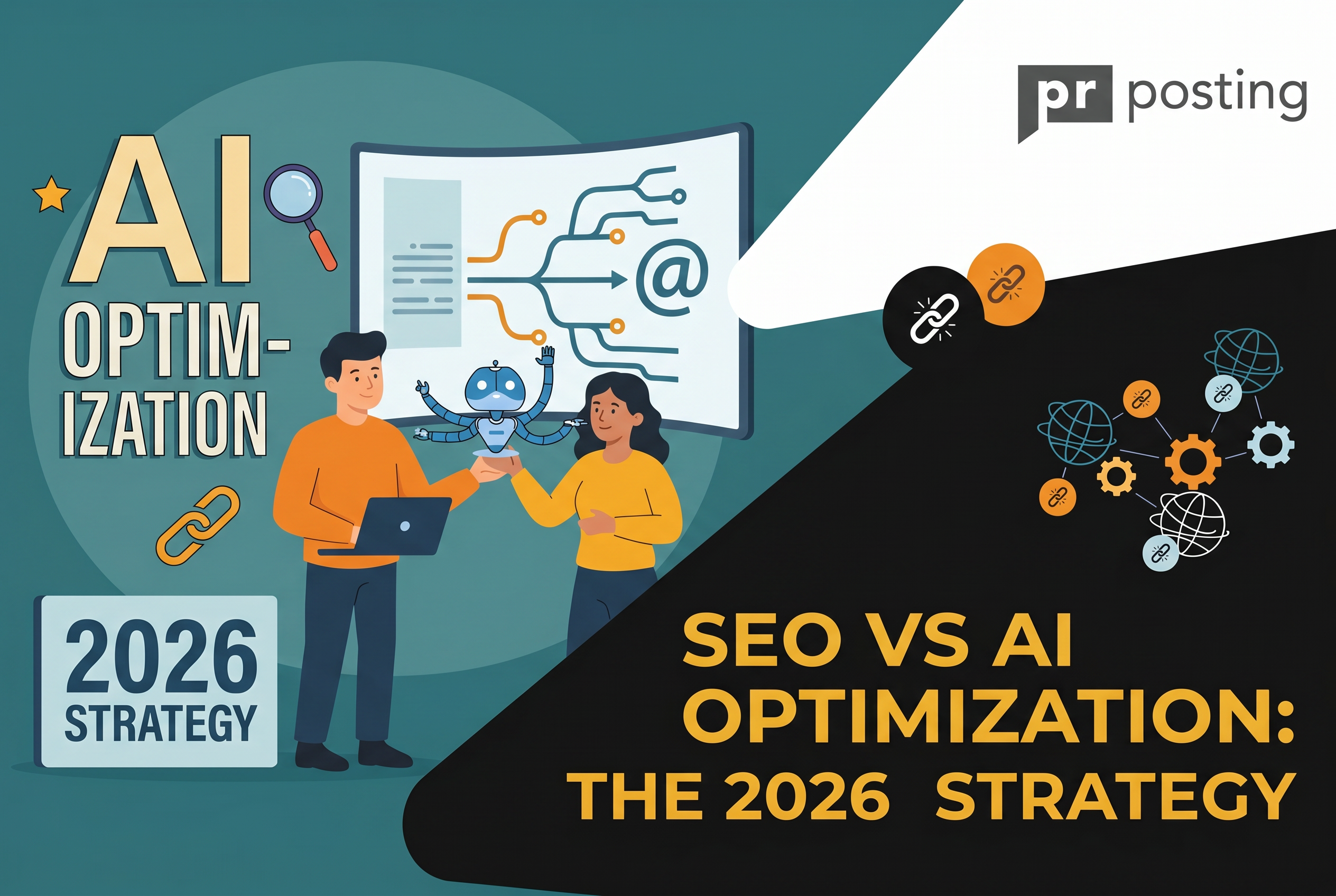
Traditional SEO wins clicks through backlinks. AI optimization wins trust through AI citations. In 2026, you must merge both into a smart strategy to stay visible.
Key Takeaways
- Hybrid Strategy. Use SEO to drive traffic and AEO (search engine optimization) to build trust and authority.
- Entity Power. Focus on facts, not just keywords.
- Citation. Become the trustworthy source to capture the top spot in AI search.
- Structured Data. Organized data is the bridge between your content and AI comprehension.
What is SEO vs AI Optimization?
SEO vs AI optimization is the choice between ranking in a list and being the answer.
SEO targets search engines to drive website visits. AI optimization targets Large Language Models to earn mentions in AI summaries.
Success requires balancing link clicks with LLM citations.
- Factual Foundations. LLMs love numbers.
- Clear Entities. Define your topics clearly.
- No Fluff. Get to the point fast.
Use Schema markup. It acts as a map for AI bots. Without it, your content is just a wall of text.
What is Traditional SEO?
Traditional SEO focuses on gaining backlinks via keyword matching. It relies on domain authority and technical site health.
You optimize to rank high in Google’s index. The goal remains simple: get a human to click your specific backlink.
What is AI Optimization?
AI optimization structures content for ingestion by LLMs like Gemini or SearchGPT.
It prioritizes factual density and entity salience. You provide clear data that models can synthesize easily. This process turns your brand into a cited source.
Why the Distinction Matters
SEO drives traffic. AI optimization builds reputation. If you ignore AI search optimization, your brand fades.
Users now prefer AI Overviews for quick answers. Without AI visibility, you lose the “zero-click” segment of your market.
Comparison: SEO vs AI Optimization
| Feature | Traditional SEO | AI Optimization (AEO) |
| Primary Goal | Clicks to the website | Cited as a factual source |
| Metric | Organic CTR | Citation Share / Mentions |
| Content Style | Narrative / Engaging | Fact-dense / Structured |
| Output | Search Result Pages | Conversational Responses |
Recent data from PYMNTS shows that 52 % of users start journeys with AI.
The Importance of the Information Gain
AI models seek “Information Gain.” This means providing new, unique data.
If you repeat what everyone else says, an LLM ignores you. Add original charts. Share raw data.
- Entity Discovery. Identify your core topic.
- Relationship Mapping. Link your brand to expert concepts.
- Contextual Relevance. Solve the user’s problem immediately.
Visibility Goals
Traditional SEO optimization aims to rank first in search results to attract direct clicks. AI optimization focuses on positioning in AI-generated snippets.
Technical Requirements
Traditional SEO demands fast load times, mobile responsiveness, and keyword-rich titles to satisfy crawlers.
AI optimization requires robust schema markup, entity clarity, and granular, fact-based content blocks.
AI systems favor “semantic units” or passages between 134 and 167 words for their summaries.
You must use JSON-LD to define your brand’s relationship to core industry concepts.
How Does AI Optimization Work?
AI optimization functions by making your content AI-readable, verifiable, and unique. It moves away from keyword matching and toward entity-based SEO.
This process ensures LLMs can ingest, categorize, and trust your data as a primary reference. Quality content in 2026 uses structured formatting to bridge the gap between human readers and AI agents.
Entity-Based SEO
Entity-based SEO uses structured data to define “things” rather than just “strings” of text. By implementing JSON-LD, you provide a map of your brand’s identity and expertise.
This allows both the Google index and models like Gemini to recognize your authority. In fact, pages using a full multi-modal schema see a 317% increase in AI citations.
Comparison of Search Strategies
| Feature | Traditional SEO | AI Optimization (AEO/GEO) |
| Primary Metric | Keyword Ranking | Citation Share |
| User Action | Click to Website | Consumption of Summary |
| Content Goal | Engagement & Conversion | Factual Synthesis |
| Key Signal | Backlinks & Authority | Entity Salience & Facts |
Will AI Overviews replace traditional search results?
No. They coexist. AI Overviews satisfy quick informational needs, while traditional results serve users seeking deep dives or transactions.
What is the best way to get cited in AI responses?
Use traditional SEO vs AI answer engine optimization tactics. Lead with a direct 50-word answer. Follow with a unique statistic or expert quote.
Does word count still matter for AI?
Yes. Long-form content over 2,000 words is twice as likely to be cited. The AI needs enough depth to extract multiple “knowledge blocks.”
How do I measure AI optimization success?
Track your brand mentions in AI summaries. Use tools to monitor citation share alongside traditional organic traffic.
How to Implement SEO vs AI Optimization: A Step-by-Step Guide
Traditional SEO vs AI SEO comparison 2026 is not about choosing a side. It is about layering tactics.
You must maintain your organic rankings while feeding the Large Language Models (LLMs) the structured data they need.
Step 1: Audit Current Visibility
Identify where you rank in traditional search versus where you are cited in AI Overviews.
Use specialized tracking tools to monitor your citation share across platforms like Gemini and SearchGPT.
Step 2: Optimize for Intent
Categorize keywords by user intent to deploy the right strategy. Informational queries now trigger AI Overviews in 57.9% of searches, making them prime targets for AI Optimization.
Transactional queries, however, still rely heavily on traditional SEO for direct conversions.
Step 3: Enhance Entity Clarity
Use explicit definitions within your headers to help the AI understand your content.
LLMs prefer sections between 100 and 150 words for easy extraction into summaries.
Avoid vague pronouns. State your subject clearly in every paragraph to anchor the context for machine parsers.
Step 4: Build Citations
Move beyond simple guest posting. Focus on earning mentions in high-authority sites like industry journals, research databases, and news outlets.
AI models prioritize these trustworthy platforms when synthesizing answers.
Data suggests that pages updated within the last three months are more likely to be cited by AI.
Common Mistakes to Avoid
While SEO requires technical health, AI optimization demands semantic precision and data uniqueness.
Failing to distinguish between them causes loss of visibility in AI Overviews and traditional SERPs.
SEO vs AI Optimization Checklist
To win in 2026, you must audit your content against both AI and human requirements.
This checklist ensures your content meets traditional SEO and AI visibility criteria, with a focus on machine readability and actual depth:
- Is my JSON-LD schema detailed and verified? Use Schema.org to define entities clearly for search bots.
- Does my content answer the “Why” and “How” for every entity mentioned? LLMs prioritize causal relationships over simple lists.
- Are my H2/H3 headers query-based and concise? AI models prefer headers that mimic user questions.
- Am I creating unique, data-backed insights? Originality is the primary signal for Information Gain.
Common Mistakes to Avoid
Avoiding errors ensures that your content remains retrievable and is considered authoritative.
LLMs ignore content that lacks a clear structure or has a robotic tone.
Ignoring the Human Element
Artificial intelligence models prioritize human preferences. If content seems soulless, it loses credibility. Search engine users want to hear from experts.
Models like Gemini prioritize content that showcases real-life experiences. Write for people first.
Keyword Stuffing
Modern AI uses Natural Language Processing (NLP). Stuffing keywords disrupts the semantic flow. It harms your extractability.
Search engines now understand context without repetitive phrases. Focus on entity-based SEO instead.
Neglecting Fragment Links
Many sites skip descriptive IDs on headers. This makes it harder for AI to deep-link to specific answers.
Fragment links allow AI agents to point users to precise sections of your page. Better navigation leads to better citations.
Conclusions
In 2026, the search environment demands a shift in priorities. Relying solely on backlinks is no longer viable. The only way forward is a hybrid approach (traditional SEO plus AI-powered optimization).
By mastering traditional and AI-powered SEO methods in 2026, you’ll secure a place in both search indexes and AI rankings.
Structure your data with schema markup. Write with high factual density. Above all, provide value that no AI can synthesize.
The future belongs to the brands that provide the best answers, not just the best keywords.
FAQs
How do I track my AI visibility?
Traditional SEO tools like Google Search Console now include AI Mode clicks.
However, you should add Generative Engine Optimization (GEO) trackers to see your specific citation frequency.
Does schema markup really help with AI?
Yes. Using JSON-LD triples your chances of being selected for an AI Overview. It translates your text into a format that AI can verify instantly.
Should I stop writing for keywords?
No. Keywords still signal the topic. But in 2026, entity-based SEO is the priority.
You must describe the relationships between concepts, not just repeat a phrase.
What is “Information Gain” in 2026?
It is the unique value your content adds compared to the top 10 results. AI models filter out repetitive content.
To be cited, you must provide original data, expert quotes, or a different perspective.
Is long-form content still relevant?
Incredibly so. Articles over 2,000 words are roughly 30% more likely to be cited by AI assistants.
The depth of information allows models to pull multiple “knowledge blocks” for complex answers.
Does SEO still matter in 2026?
Yes. SEO provides the foundation for discovery. AI models often use search indexes to find the latest information.
What is the biggest risk of ignoring AI optimization?
Your brand disappears from zero-click summaries. Users get their answer from the AI.
If AI does not cite you, the user never hears about your brand.
How does traditional SEO vs AI answer engine optimization (AEO) differ in 2026?
SEO is about site health and links. AEO is about being the most accurate and trustworthy source for AI citations. You need both to survive.
Should I use AI to write my AI-optimized content?
Only as a tool. Raw AI output often lacks information gain. It merely repeats its training data. Add original data to stand out.
What is the biggest difference between traditional SEO vs AI SEO?
Control. In SEO, you control the meta tag. In AI, the model rephrases your content. You must be clear so the model stays accurate.
How do I get cited by AI?
Use traditional SEO vs AI answer engine optimization tactics. Write in short, declarative sentences. Use bullet points for lists. Cite your sources clearly.



More Like This
Link Building for AI: Google AI Mode Tactics
Technical SEO KPIs: Tracking What Actually Matters