
Technical SEO KPIs: Tracking What Actually Matters
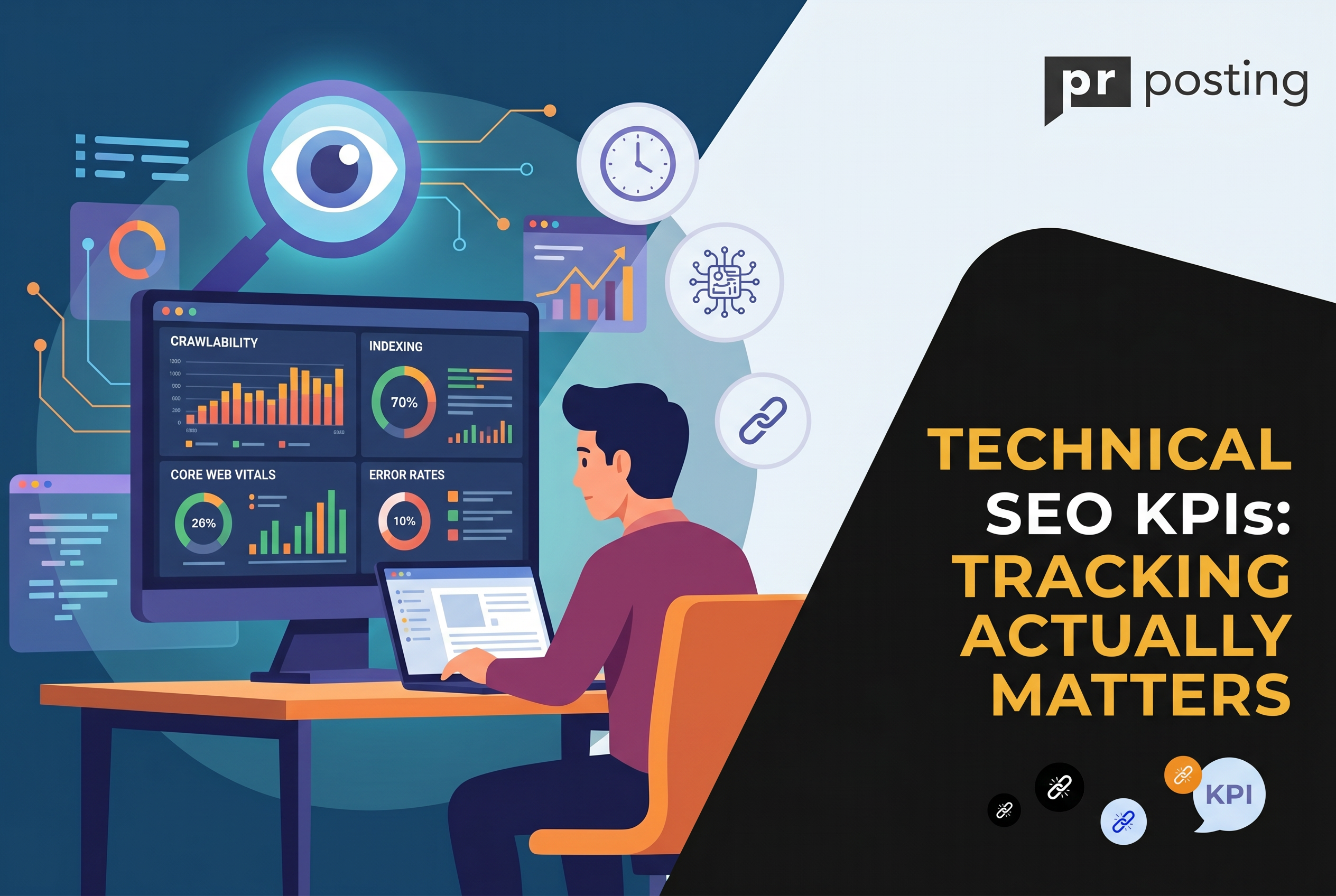
In 2026, these metrics will go beyond simple link counts. You should now evaluate success by metrics such as the presence of AI, the clarity of your entities, and the effectiveness of search engine crawlers within your site’s architecture.
Key Takeaways
- Entity-First. Modern search engines using artificial intelligence reward brands that are recognized as distinct nodes in the knowledge graph.
- Hybrid Reporting. Your SEO KPI report template must merge traditional clicks with LLM citation frequency.
- Technical SEO KPI is Non-Negotiable. A technical SEO KPI list ensures your site remains a fast, indexable foundation for all AI agents.
- Separate brand and non-brand data.
- Monitor AI Overview (AIO) footprints.
- Verify conversion links.
What is the SEO KPI?
An SEO KPI is a high-level metric aligning search performance with actual revenue or lead generation.
While basic metrics track general data, a KPI focuses only on the vitals needed for fast pivots.
It filters out the noise to show if your organic investment actually pays the bills.
SEO KPI Meaning and Fundamentals
The SEO KPI meaning primarily reflects the confirmation of your content’s effectiveness online.
Currently, success depends on measuring audience reach both on Google and on AI platforms like ChatGPT and Gemini. Relying on just one source is currently risky.
| Metric Type | Example Metric | Why It Matters |
| Traditional | SEO KPI metrics | Tracks historical growth on legacy search engines |
| Generative | AI Citation Share | Measures how often LLMs recommend your brand |
| Technical | Indexation Efficiency | Ensures bots don’t waste time on dead ends |
Why SEO KPIs Matter for AI Search (AEO)
AI search engines use entity-based indexing to provide direct answers. If you don’t track technical SEO KPI data, your brand stays invisible to these systems.
AEO requires your data to be structured, clear, and highly reachable.
Entity Salience
How often does an AI mention you? This is the new frontier. You need an SEO KPI dashboard that monitors entity salience.
It reflects how well an AI understands your specific niche. High entity salience means you become the trusted source for the LLM.
- Cite your sources. Research by Search Engine Land indicates that 47% of users now trust AI-generated summaries for purchase decisions.
- Speed kills. A 100ms delay in load time can drop conversion by 7%.
- Structure. Over 67% of AI Overviews pull data directly from Schema-marked content.
Technical SEO KPI List: The 2026 Essentials
The technical SEO KPI list below will help you monitor your website for issues.
If these key performance indicators aren’t met, your content will never make it into AI training datasets.
- Crawl Budget Waste. Monitor how many non-essential pages bots visit daily.
- Schema Coverage. Ensure 100% of your products or articles use valid JSON-LD.
- Core Web Vitals. Focus on Interaction to Next Paint (INP) to keep users happy.
- Edge SEO Practices’ Effect on Latency. Track content delivery speed globally to ensure a fast experience for users worldwide.
Core SEO KPI Metrics for Growth
The primary SEO KPI metrics for growth involve tracking organic traffic quality and Share of Voice (SOV) relative to market competitors.
Rapid growth strategies prioritize user intent over mere traffic volume. Success is determined by how effectively a brand attracts and retains search engine user attention across various search platforms.
In 2026, growth metrics move beyond simple clicks. Look at the quality of the audience. Are they just browsing? Or are they ready to buy?
Tracking SEO KPI data helps distinguish between these groups. It ensures marketing budgets actually fuel expansion.
Organic Traffic and Share of Voice (SOV)
Organic traffic is the total number of unique visitors arriving via non-paid search results.
Share of Voice (SOV) measures your brand’s visibility compared to all available search opportunities in your niche.
Together, these provide a snapshot of market dominance and brand authority.
- Share of Voice. Your brand should occupy at least 25% of top-tier entity keywords.
- Competitor Gap. Use an Ahrefs SEO KPI audit to find keywords your rivals own but you lack.
- Visibility Index. Track how often your Knowledge Graph entry appears for key industry terms.
Tracking Organic Traffic by Intent
Intent-based tracking classifies traffic into categories: informational, transactional, and navigational, to assess the sales funnel.
This allows strategists to see where the content strategy succeeds or fails. It prevents content types from misaligning with user needs.
- Informational. People want answers. High volume here builds your authority.
- Transactional. People want to buy. These visits carry the highest immediate monetary value.
- Navigational. People look for you by name. This tracks brand recall and loyalty.
Conversion Rate and SEO ROI
SEO ROI is the financial return generated from organic search relative to the total cost of production and optimization.
Conversion rate measures the percentage of visitors who complete a specific desired action. Calculating this requires comparing customer lifetime value (LTV) against your costs.
Technical SEO KPI List: Health & Performance
A technical SEO KPI tracks the underlying infrastructure that allows search engines to access and understand your site.
These metrics focus on crawlability, indexation, and the speed of content delivery. Without technical health, even the best content remains invisible to LLMs and crawlers.
Modern technical SEO KPI data warns you before the engine stalls. This opens the door to Googlebot and Gemini.
Crawlability and Indexation Metrics
Crawlability is the ease with which search bots navigate your site structure.
Indexation is the actual inclusion of those pages in a search engine’s database.
Monitoring the gap between “discovered” and “indexed” pages reveals critical structural bottlenecks.
- Crawl Budget. Ensure bots spend time on high-value pages.
- Sitemap Health. Your XML sitemap must be clean of redirects or 404s.
- Robots.txt. Check for accidental blocks that hide your best work.
How to Measure Technical SEO KPI Improvement
To measure technical SEO KPI improvement, compare your current crawl error rates and indexation ratios against historical benchmarks.
A decreasing error rate and a rising indexation ratio indicate a healthier, more accessible site.
Use an SEO KPI dashboard to visualize these trends over time.
| Metric | Target Goal | Impact |
| Crawl Error Rate | < 1% | Improves bot efficiency and server health. |
| Indexation Ratio | > 95% | Maximizes content visibility in SERPs. |
| LCP Speed | < 2.5s | Boosts user retention and ranking potential. |
Site Speed and User Experience (UX)
Site speed measures how fast content loads and becomes interactive for the visitor.
User Experience (UX) includes the visual stability and responsiveness of the interface.
High-performance sites see lower bounce rates and better ctr as SEO KPI results.
- Time to First Byte (TTFB). Your server should respond in under 800ms.
- Interaction to Next Paint (INP). This measures how fast the page reacts to a click.
- Visual Stability. Avoid layout shifts that annoy users.
Behavior Metrics: CTR, Engagement, and Authority
CTR Optimization
CTR as an SEO KPI requires a dual approach to be effective.
Use monthly data to measure the impact of new meta titles or description tests. Shift to a yearly perspective to filter out seasonal noise and track long-term brand trust.
Monthly vs. Yearly CTR Analysis
- Monthly. This is your tactical playground. Did that new emoji in your title boost clicks? Check here. This helps you quickly adapt when competitors change their snippets.
- Yearly. This reveals the big picture. It shows if your brand is gaining genuine authority over time. Use this to normalize your data to account for holiday peaks or summer lows.
What to do next:
If your monthly SEO KPI for CTR drops but rankings stay firm, look at the SERP.
AI Overviews or “People Also Ask” blocks might be stealing your clicks. You probably need a more compelling headline to regain users’ attention.
Backlink Profile and Topical Authority
High-authority referring domains signal to search engines that your entity is a trusted source.
According to a Backlinko study by Brian Dean, the number of domains linking to a page correlates with rankings more than any other factor.
| Metric | Purpose | Frequency |
| Referring Domains | Measures unique site trust | Monthly |
| Link Velocity | Tracks growth speed | Quarterly |
| Domain Rating (DR) | Estimates overall authority | Monthly |
The Professional SEO KPI Report
How to Create an SEO KPI Dashboard
Step-by-Step SEO KPI Reporting Guide
- Define the Goal. Start with a clear target like a 20% increase in MQLs.
- Select Tools. Use Google Search Console for SE KPI metrics, and Ahrefs for competitive gaps.
- Aggregate Data. Connect your sources to Google Looker Studio for a real-time SEO KPI report template.
- Analyze Trends. Compare Month-over-Month (MoM) and Year-over-Year (YoY) to spot anomalies.
- Action Items. Every SEO KPI report must end with a “Next Steps” list.
Common Mistakes & Pitfalls in SEO KPI Reporting
Vanity Metrics in SEO KPI Reports
Experts distinguish between “Total Keywords Ranked” and “Keywords with High Search Intent.”
Total rankings often include low-value terms that never convert. A professional SEO KPI report focuses on queries indicating a readiness to buy.
This alignment secures a better return on investment for marketing spend.
- Search Intent. Group keywords by informational, commercial, or transactional categories.
- Conversion Rate. Track how many visitors take a specific action.
- Revenue Per Lead. Calculate the actual dollar value of leads.
Essential Technical SEO KPI List Checklist
A modern technical SEO KPI audit must include Interaction to Next Paint (INP).
This metric measures the speed of all user interactions on a page.
- Revenue Connection. Are your selected SEO KPI metrics tied to profit?
- Speed Metrics. Does your technical SEO KPI list prioritize INP and LCP?
- AI Visibility. Are you tracking your brand footprint in AI Overviews?
- CTR Monitoring. Do you measure CTR monthly and annually?
- Health Score. Do you use Ahrefs SEO KPI to monitor crawl health?
Failure to distinguish between branded and non-branded traffic undermines SEO KPI reporting. Branded traffic measures existing brand awareness.
Non-branded traffic is an indicator of real SEO growth. Mixing these approaches masks the true effectiveness of your content strategy.
| Reporting Error | Impact | Fix |
| Volume over Quality | High bounce rates | Filter for intent |
| Ignoring Brand Split | Skewed growth data | Use Regex filters |
| Static Dashboards | Outdated insights | Build a real-time SEO KPI dashboard |
Focusing on maximum volume leads to a waste of resources. One hundred targeted visitors are always more effective than ten thousand irrelevant ones.
High-quality SEO KPI reporting allows you to identify specific users who need your product or service. Avoid the trap of chasing empty traffic spikes.
Conclusions
Mastering SEO KPI metrics means going beyond simple ranking tables.
Your SEO KPI dashboard should reflect these changes. Track AI mentions. Monitor technical health, for example, using INP. Most importantly, always connect your data to business growth.
Clear SEO KPI reporting builds trust with stakeholders. It proves that SEO is a revenue generator. Stop looking at superficial numbers.
Start analyzing user intent. Use the provided checklists to audit your current strategy today.
FAQs
What is SEO KPI meaning in simple terms?
An SEO KPI is a specific value used to track how well your search engine optimization efforts work. It connects technical work to business growth.
How do I measure technical SEO KPI improvement?
Track your Core Web Vitals and crawl error rates in Google Search Console. A decrease in “Indexed but not submitted in sitemap” pages is a win.
What is a good SEO KPI report example for clients?
A great SEO KPI template includes organic traffic growth, keyword movements, and conversion rates.
It should also highlight technical SEO KPI wins like improved page load speeds.
How to do SEO KPI report automation?
Use connectors like Supermetrics to pull SEO KPI reports into Google Sheets. This saves time and keeps your SEO KPI dashboard updated without manual entry.
Don’t just report on rankings. Focus on “Share of Voice” in AI Overviews to see how often LLMs cite your brand.
What is KPI in SEO for 2026?
It now includes AI citation share and entity salience. You are tracking how often AI models recommend your brand.
What is KPI in SEO?
It is a vital sign for your website’s health. It helps you ignore vanity metrics like total impressions and focus on conversion-ready traffic.
How to do an SEO KPI report?
Start with the business goal. Pick three SEO KPI examples like organic revenue, entity share, and crawl health. Use an SEO KPI template to keep the visual data clean for stakeholders.
Should I use monthly or yearly data for CTR as an SEO KPI?
Look at the monthly trend for agility. Use the yearly view to spot seasonal shifts.
Ahrefs SEO KPI tools allow you to toggle these views easily to see long-term growth.
How to do SEO KPI report analysis for AI?
Track Share of Voice within LLM responses. Use tools that monitor citations in Google AIO and Perplexity.
What is KPI in SEO for local businesses?
Focus on “Calls” and “Direction Requests.” These intent signals prove local search dominance.
Can I find an SEO KPI report template online?
Yes. Most pros use Google Looker Studio. Use an SEO KPI template that pulls directly from Google Search Console.



More Like This
Enterprise SEO and Link Building

How to Scale with Query Fan-Out SEO