
Mastering AI Prompt Volumes for Modern SEO
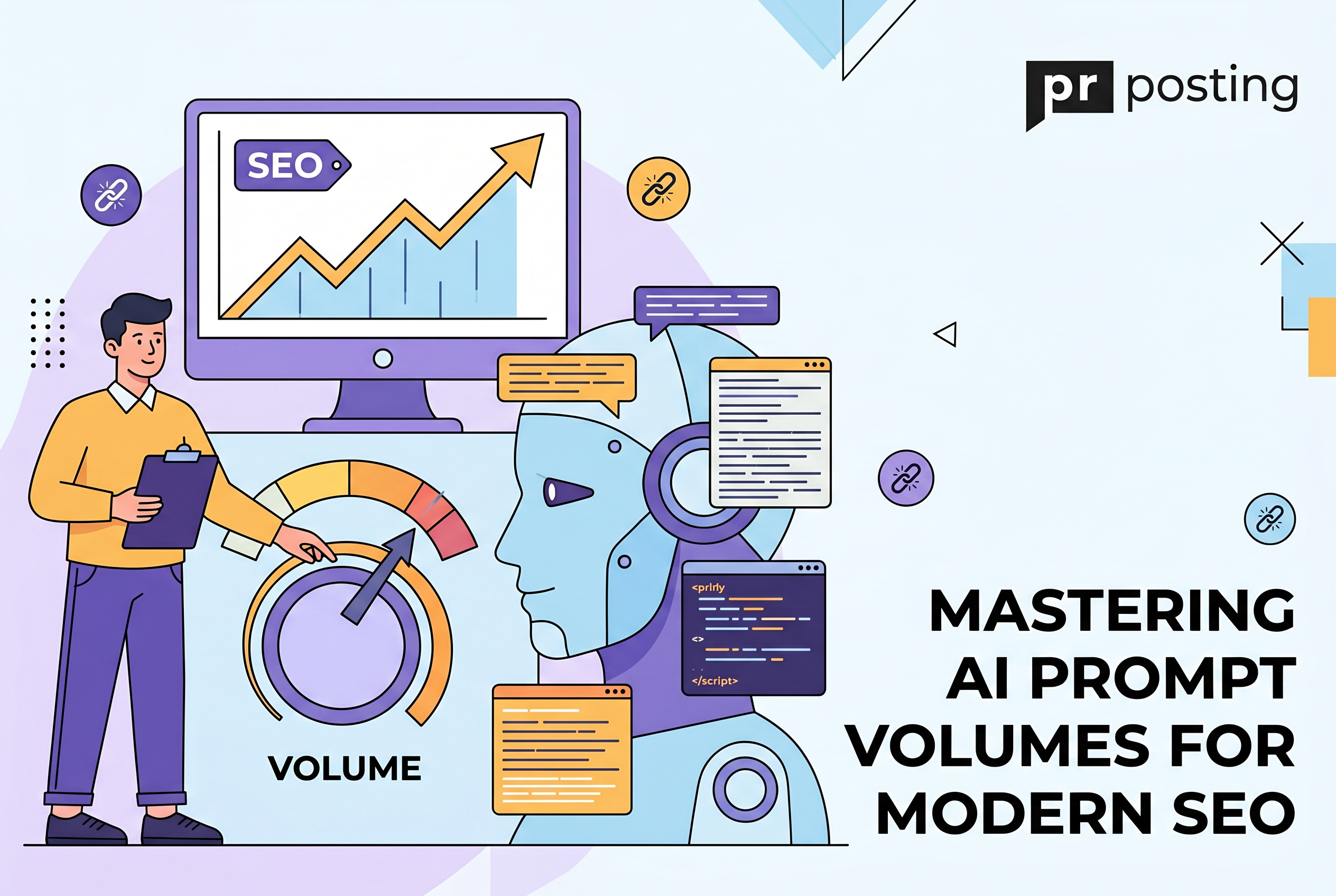
Unlike traditional search clicks, these metrics track conversational intent and problem-solving.
SEOs use this data to create content that serves as primary training data or cited sources for AI-generated answers.
Key Takeaways
- Identify the top 10 profound prompts within your specific market niche.
- Update Schema.org markup to include speakable and FAQ properties.
- Build a page for high-volume entities.
- Track brand mentions specifically within AI Overviews.
What is the AI Prompt Volume?
AI prompt volumes measure how frequently users ask AI agents about a specific entity or process.
While Google tracks keywords, AI platforms track the velocity of dialogue.
This change allows content creators to accurately see how users formulate complex, multi-step problems in the chat interface.
The shift from keywords to prompts reflects the trend toward logical information search.
Traditional search engines prioritize keyword matching. AI agents prioritize matching the underlying intent of a user’s request.
Understanding AI prompt volumes helps you align your site’s data structure with the way LLMs know about your industry.
This alignment ensures your brand remains the definitive answer when an AI synthesizes a response.
| Metric Type | Traditional SEO | AI-Native SEO |
| Primary Unit | Keywords | Natural Language Prompts |
| User Goal | Finding Links | Solving Tasks |
| Success Signal | Rank #1 | LLM Citation |
| Data Source | Search Consoles | tools for tracking AI prompt volumes |
Why AI Prompt Volumes Matter for SEO
Traditional SEO helps people find information. AI-native SEO helps people solve tasks.
The high AI prompt volume indicates users’ desire for information synthesis.
Authoritative data sources must fill this gap. If your content contains the most understandable logic, AI will cite you.
Being the first link is fine. Being the brain behind the AI’s answer is better.
In a survey of 4,270 US consumers, Deloitte found a growing interest in AI-powered shopping. More than half of respondents (56%) said they would rely on generative AI to find the best deals and compare prices.
This trend makes profound AI prompt volumes a critical metric for long-term visibility. You are competing to be the foundation of AI’s knowledge.
Profound AI Prompt Volumes: Defining Deep Intent
Profound AI prompt volumes are complex, multi-step queries that require nuanced answers.
These prompts show deep intent. They often lead to high-value conversions. Users asking these questions are usually deep in the consideration or decision phase of their journey.
- To win here, your content must be modular.
- Use clear headings.
- Provide direct answers.
- Avoid fluff at all costs.
An AI agent needs to extract your logic without getting lost in marketing speak.
When you target profound AI prompt volumes, you focus on the “why” and “how” rather than just the “what.” This depth makes your content suitable for LLMs.
It increases the chance that an AI Overview will use your specific data points to satisfy a user’s complex request.
Use Case: Technical Documentation
Brands mapping technical documentation to profound queries see 40% higher citation rates in AI Overviews. This beats sites targeting keywords.
Technical docs are naturally structured. They use clear steps. They define entities. This makes them perfect for AI consumption.
If you want to know how to analyze user prompt volumes for AI, look at your internal site search first.
How to Analyze User Prompt Volumes for AI
- Export your internal site search data to find question-based queries.
- Use community hubs like Reddit or Stack Overflow to find “how to” clusters.
- Check “People Also Ask” blocks for multi-step logic patterns.
- Leverage the best tools for tracking AI prompt volumes like Glimpse or SparkToro.
Best Tools for Tracking AI Prompt Volumes
Tracking AI prompt volumes requires shifting focus from simple clicks to linguistic patterns.
Since LLM providers keep internal logs private, marketers use proxy data from search trends and conversational mapping.
Best tools for tracking AI prompt volumes include Glimpse, AnswerThePublic, and Semrush to reveal how users structure natural language tasks.
Estimating prompt frequency involves analyzing conversational nodes via keyword extensions and trend aggregators.
Tools like Glimpse AI provide visibility into how users ask LLMs to perform specific actions. These insights help bridge the gap between traditional search and generative AI intent.
How to Measure AI Prompt Volumes
Large Language Models function as “black boxes” regarding specific usage statistics. You cannot view exact prompt logs from OpenAI or Anthropic.
Instead, you can use specialized software to observe how users transition from search engines to AI interfaces.
Gartner reports that search engine volume could drop 25% by 2026 as users migrate to AI agents.
Essential Software for AI Prompt Volume Analysis
Top AI Tools for Prompt Analysis Comparison Table
| Tool Category | Recommended Tool | Primary Use Case |
| LLM Tracking | Glimpse / Google Trends | Monitoring “how to use” trend velocity |
| Natural Language | AnswerThePublic | Identifying the “Who/What/Why” of prompts |
| Search Intent | Semrush (Topic Research) | Mapping clusters to conversational nodes |
| Synthetic Data | Custom GPTs | Predicting profound AI prompt volumes |
Glimpse / Google Trends
Glimpse adds a layer of depth to standard Google Trends data.
It identifies rising interest in specific AI-human interactions. You can see when users stop searching for a “calculator” and start asking “how to calculate X with AI.”
This data reveals the velocity of AI prompt volumes for specific brand entities. It captures the moment a tool becomes a prompt-based solution.
AnswerThePublic
This tool visualizes the interrogative structure of user queries. It maps out the “can,” “where,” and “how” of a topic.
These visualizations represent the likely starting points for LLM conversations.
By targeting these questions, you provide the trustworthy source for AI systems to cite. It is a gold mine for identifying profound AI prompt volumes before they peak.
Semrush (Topic Research)
Semrush allows strategists to group keywords into semantic clusters.
This clustering mirrors how LLMs categorize information. You can identify the specific nodes where users exhibit deep, multi-step intent.
It helps you understand how to analyze user prompt volumes for AI by looking at related searches that imply a dialogue.
Focus on clusters with high question density to capture AI citations.
Custom GPTs
Building a custom GPT allows you to simulate your target audience. You can observe the exact paths a user might take when solving a complex problem.
This creates synthetic data to predict AI prompt volumes in your niche. It acts as a laboratory for testing which content structures trigger specific AI responses.
Use this to refine your knowledge modeling before publishing.
How to Analyze User Prompt Volumes for AI
Analyzing user prompt volumes for AI involves identifying natural language patterns. This marks a shift from search engine navigation to task-oriented dialogue.
Strategists extract core entities, group them into intent clusters like “Instructional” or “Comparative,” and monitor the velocity of these queries via tools like Glimpse or SparkToro.
This approach reveals where users prefer AI answers over traditional website links.
Data analysis for prompt volume centers on mapping conversational nodes and entity relationships.
By identifying “Gap Velocity,” where user queries rise but quality web citations fail, brands can capture AI Overview visibility.
Validating these trends through social listening ensures content addresses real user frustrations and AI hallucinations.
Step-by-Step Guide to Data Analysis
Traditional keyword research is no longer enough. It’s now necessary to decipher the logic behind complex user interactions.
To stay relevant, follow this structured workflow to decode AI prompt volumes:
- Extract Entity Seed Lists. Identify the specific topics, products, or processes your brand definitively owns. These are your primary knowledge nodes.
- Map Intent Clusters. Categorize queries into “Informational,” “Instructional,” or “Comparative” buckets. AI agents prioritize different data structures for each intent.
- Analyze Gap Velocity. Search for topics where AI prompt volumes are surging, but current web citations are rare or inaccurate.
- Validate via Social Listening. Monitor Reddit or Discord threads. If users report that AI is “hallucinating” or failing on a topic, create the definitive source to correct the record.
| Analysis Step | Actionable Output | Impact on AI Overview |
| Entity Extraction | Knowledge Graph Schema | Improved Entity Recognition |
| Intent Mapping | Sectional Formatting | Higher Matching Accuracy |
| Gap Analysis | New “Source of Truth” Pages | Primary Citation Status |
| Social Validation | Fact-Checked Clarifications | Brand Trust & Accuracy |
Common Mistakes to Avoid
Many marketers fail because they treat prompts like keywords. This is a mistake. A prompt is not a static string. It is a piece of a larger puzzle.
Research shows that LLM-referred visitors convert at roughly 4x the rate of traditional search visitors. If you miss the intent, you miss traffic.
Treating Prompts like Keywords
Stop optimizing for “best laptop.” Instead, optimize for “Which laptop is best for a student who does video editing?”
The latter reflects a specific phase of the user journey. Keywords often fail to trigger the detailed AI prompt volumes that lead to conversions. Your content must answer the specific question, not just the product name.
Ignoring the Context
Every prompt exists within a conversation thread. If your page only answers a tiny slice of a problem, the LLM may look elsewhere for a comprehensive solution.
Ensure your headers and FAQs cover the “what happens next” for the user.
Using the tools for tracking AI prompt volumes helps you see these conversational extensions before you write a single word.
Is prompt volume different from search volume?
Yes. Search volume measures clicks. Prompt volume measures the frequency of specific, dialogue-driven tasks within AI models.
How do I find gaps in AI citations?
Test common industry prompts in Gemini or ChatGPT. If the AI lacks a source or provides vague info, that is your opportunity.
Does social media impact AI citations?
Absolutely. Platforms like Reddit are major training sources. Mentions there often correlate with higher citation rates in AI Overviews.
Link Building Through AI Prompt Optimization
Modern link building focuses on acquiring LLM citations by aligning content with high AI prompt volumes.
A citation occurs when an AI model credits a specific source as the authority for its generated answer. To earn citations, creators must provide structured, fact-based data that satisfies conversational user intent.
This process shifts the goal from solely accumulating backlinks to becoming the foundational training data for AI agents. AI-native link building treats every citation in a generated response as a high-authority backlink.
By structuring data through Schema.org and providing original research, brands ensure AI models retrieve their content.
This strategy targets the logic of LLMs, securing visibility within AI Overviews and chat interfaces.
The Evolution of the Backlink
The definition of a backlink has changed. In Answer Engine Optimization (AEO), a citation is the new basis.
When an AI states, “According to [Your Brand], the best method is…” and provides a link, you have succeeded. This citation acts as the modern equivalent of a high-quality backlink. It signals trust directly to the user within the answer itself.
Recent data suggests that 33% of Gen Z users now utilize AI chatbots as their primary starting point for product discovery.
This shift means online visibility depends on being a trustworthy source for AI engines.
Traditional search engines might rank you. AI agents must trust you. You are building authority for the software that answers the user, not just for a search algorithm.
Strategies for Citation Acquisition
Winning awards requires more than just good writing. A data-driven approach is essential.
AI models prefer information they can analyze without ambiguity. If your content is vague, the AI will ignore it. In this case, high information density is the best approach.
- Create original, data-backed reports. AI models use these to ground their answers on facts. By providing unique statistical data, you become an indispensable node in the knowledge graph.
- Make your data accessible. Use Schema.org markup. This helps AI agents parse your site easily. It turns your web pages into a structured database that LLMs can query in real-time.
Final Thoughts
The future of SEO isn’t in a list of links. It’s in the logic of responding to a user’s query.
Your job is to provide the most reliable, structured, and understandable answer. If you master AI prompt volume analysis, you will control the course of events.
Content quality remains fundamental. Structure is also crucial. You need to become a reliable and indispensable source of information for AI engines.
Brands that ignore AI-powered SEO tools will fade into the background. Those that adapt will become the future of the internet. Focus on usefulness and clarity of presentation. AI will do the rest.
FAQs
What is the most accurate way to find AI prompt volumes?
Analyze rising “how-to” trends in Google Search Console. These often correlate directly with AI chat intent.
Can I see exact numbers from ChatGPT?
No. LLM providers do not share private user prompt counts. Use Glimpse or SparkToro as credible proxies.
Why should I care about profound AI prompt volumes?
Deep, multi-step prompts indicate a user is ready to make a decision. Solving these complex tasks earns you a citation in AI Overviews.
How do I track prompt volumes?
You can use tools that monitor “zero-click” trends and conversational search patterns.
Is keyword research dead?
No. It is evolving. Keywords now act as the “entities” inside larger, more complex prompts.
Can small blogs compete?
Yes. Precision and unique data matter more than domain authority in AI citations.
What is an LLM citation?
It is a direct link or mention within an AI-generated answer. It credits your website for specific facts or advice.
How do I get cited more often?
Use clear, declarative sentences. Provide unique data that no one else has. Structure your site with technical SEO best practices.
Do traditional backlinks still matter?
Yes. They help build initial trust. However, AI agents also look for information density and factual accuracy.



More Like This
LLM Visibility Software: Master AI Search Results
SEO vs AI Optimization: The 2026 Strategy