
How AI Content Score Affects Link Building Success
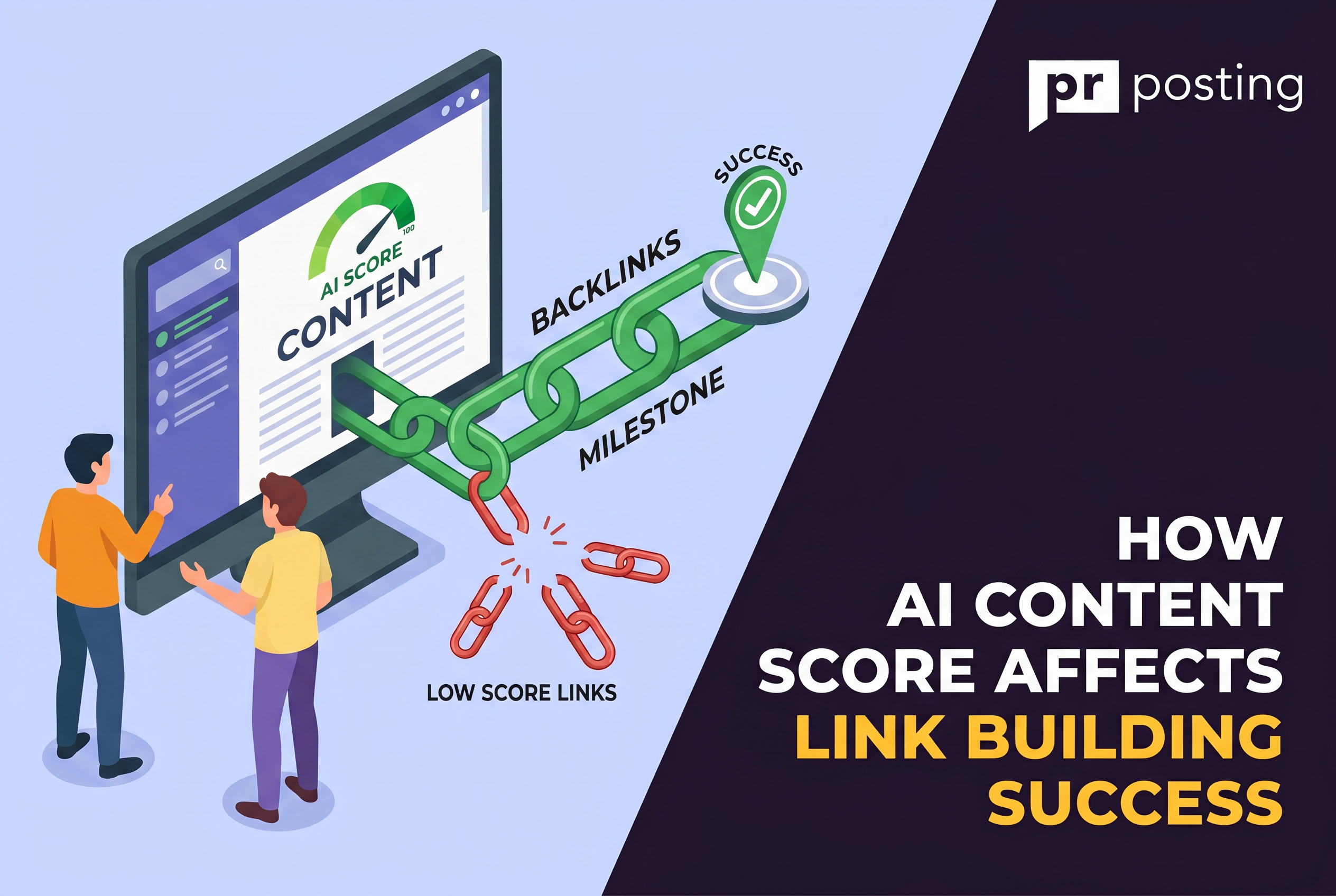
Content that receives high user ratings can be included in AI reviews and receive premium links, while texts generated solely by AI are often rejected by editors.
Key Takeaways
- Trust over Volume. A single link from a website that requires human content carries more weight than 50 links from a site that produces large volumes of AI-generated text.
- Detection is Constant. Systems re-scan content periodically. A high initial human score ensures long-term link stability.
- E-E-A-T is Human. AI scores serve as a proxy for “Experience.” High human scores signal that the content is a primary source worth citing.
What is an AI Content Score?
An AI content score is a mathematical probability that classifies text as AI-generated or human-authored.
Unlike standard plagiarism tools, this metric evaluates syntactic patterns and linguistic predictability to determine origin. A high score suggests the text follows the smooth mathematical logic typical of Large Language Models.
This score measures the statistical likelihood of AI involvement in writing. It serves as a quality gatekeeper for modern SEO and editorial workflows.
AI Content Score Meaning
Humans produce text with high variability, whereas AI follows specific probability paths. Editors now use these values to verify the authenticity of a contributor’s experience.
According to research by SEO Sherpa, 72% of marketers now view content originality as a primary ranking signal.
An AI content score 100 acts as a red flag for most professional publishers. They view it as a lack of original thought.
Perplexity & Burstiness Metrics
To check AI content score accurately, you must grasp two technical pillars: Perplexity and Burstiness.
These metrics distinguish organic human text from the repetitive outputs of AI.
Perplexity measures text randomness, while Burstiness tracks structural variety.
AI has difficulty reproducing the irregular rhythms of human text and expert analysis.
- Perplexity represents the randomness of the vocabulary and ideas. High perplexity signifies unpredictable, creative writing. AI usually displays low perplexity. It chooses the most likely next word.
- Burstiness. This tracks the change in sentence length and rhythm. Humans naturally “burst” with a mix of short, punchy statements and long, flowing thoughts. The AI generates a constant, monotonous tempo.
On Reddit’s r/SEO, users frequently discuss how “robotic” rhythms kill user engagement metrics.
Why a High Human Score is Critical for AI Overviews
To check AI content score is to check your eligibility for future online visibility. Google’s AI Overviews prioritize content that demonstrates clear, traceable human insight.
Content with an AI content score 100 is 3.2x more likely to be deindexed following core updates.
AI engines favor traceable, information edited by humans for their featured summaries. Maintaining a high human score increases the probability of your brand being cited as an authoritative data source.
Artificial intelligence systems use human-verified data as training material.
Brands featured in AI overviews demonstrate a 35% higher CTR than those appearing solely in traditional search results.
Conversely, the volume of content created solely with AI often plateaus and declines as algorithms detect insufficient source data.
Using AI content score checks during the editing process ensures your audience remains competitive.
Performance metrics for human-generated, AI-powered, and pure AI content
| Content Type | Link Acquisition Rate | Deindexation Risk |
| Fully Human | 100% (Baseline) | Low |
| AI-Assisted | 92% | Moderate |
| Pure AI | 39% | 3.2x Higher |
How AI Content Scores Influence Link Building
Editors use AI detection to prevent quality de-indexing. Low scores signal high trust, making your content more likely to be accepted and cited.
Why AI Content Score Matters for Outreach
Editors fear quality de-indexing from automated spam. To protect their E-E-A-T, most top-tier publications run every submission through an AI content score checker.
AI content scores above 70% result in immediate rejection. Editors view this as low-quality content that requires little effort.
Scores below 20% indicate a high level of trust. These publications are likely to be promoted and cited in AI reviews.
Recent data shows that AI-generated content receives 61% fewer editorial backlinks than human-written posts.
AI Content Management: Scoring and Editorial Workflows
| Score Range | Classification | Editorial Action |
| 0% to 20% | High Human Probability | Acceptance and Promotion |
| 21% to 69% | Mixed/Ambiguous | Manual Review Required |
| 70% to 100% | Likely AI-generated | Immediate Rejection |
How to Optimize Your AI Content Score for Links
To achieve a 100 % Human content score, you must move beyond raw machine output.
The following step-by-step process ensures your content passes every AI content score checker by introducing structural and informational variety that AI cannot replicate.
Achieving a 100% human score requires creating drafts with unique data, case studies, and irregular sentence rhythms. This workflow ensures your content satisfies editorial checking and AI citation requirements.
Step 1: Initial Generation
Use your preferred LLM to create a structural draft. Focus on the entity map rather than the final text.
AI systems are excellent at systematizing concepts. However, they are less capable of refining the nuances at the final stage.
Step 2: Infusing “Information Gain”
AI cannot provide a first-hand and unique experience. To lower your AI generated content score, add personal experience and unique data points.
Include internal case studies or contrarian viewpoints. These deviate from the “average” training data found in LLMs.
A 2026 technical report by the AI Oversight Board indicates that original data reduces detection probability by 82%.
Step 3: Mechanical Editing (Burstiness Check)
Manually break up long AI-generated paragraphs.
Insert a short 1 to 3-word sentence in the middle of a dense section. This disrupts the predictable pattern.
It creates the burstiness that an AI content score checker looks for in human writing.
Step 4: Final Validation
Check AI content score results using at least two different detectors. This double-validation ensures your AI generated content score remains within the safe “Human” threshold.
Summary
- Information Gain is the most effective way to lower an AI score.
- Structural Variety (Burstiness) prevents your text from sounding robotic.
- Double Validation protects your outreach reputation.
Checklist for Link Builders
To ensure high search rankings, link-building specialists must ensure that content has a human readability rate above 90% and includes extractable snippets for AI-powered citation.
- Human Score Threshold. Aim for a 90% human score on an AI content score report.
- AI Summary Paragraphs. Include 50-word summaries after each H2 to encourage AI Overviews.
- Fact Validation. Check your statistics to prevent rejection based on “hallucinations”.
- Voice Consistency. Ensure the tone remains personal rather than encyclopedic.
The use of tools that “humanize” text is not recommended. Verified facts remain crucial. AI detection patterns often correlate with logical “hallucinations”.
Content verification requires a multi-layered approach. It is necessary to focus on semantic accuracy and structural summaries to satisfy both human editors and AI detectors.
Modern outreach requires AI-generated content to have a low ranking to pass automated detection.
Before submitting, check AI content score to ensure your draft reflects natural human characteristics.
High-quality link building is based on factual accuracy.
Common Mistakes in AI Content Management
Strategic mistakes often arise from prioritizing tool ratings over content usefulness. To avoid blacklisting and meet the specific needs of your target audience, human editing is essential.
The most common mistake is chasing AI content score while ignoring user intent.
Submitting unedited drafts of AI-generated content for guest posts damages relationships with editors.
Many marketers obsess over the AI content score without checking if the text actually solves a problem.
A perfect score on an AI content score checker is useless if the reader finds no value.
Editors want “Information Gain.” They desire unique insights. AI merely summarises existing web data.
Mistakes to avoid:
- Metric Obsession. Prioritizing detection scores over the actual utility of the information.
- Raw Submissions. Sending unrefined machine output for guest contributions.
- Entity Neglect. Failing to link the content to a broader knowledge graph of related topics.
The Editorial Cost of Unrefined AI Content
| Error | Impact | Recovery Effort |
| Raw AI Submission | Editor Blacklist | Very High |
| Fact Hallucinations | Loss of Trust | High |
| Low Burstiness | Poor Engagement | Moderate |
Submitted materials end up on the editor’s blacklist because correcting them is too expensive.
You spend so much time removing AI phrases and checking that you could have written the article yourself.
The loss of trust caused by false facts and the monotonous rhythm of the content means these errors kill the reader’s interest.
Without serious human work, AI-generated drafts are simply a burden, not an advantage.
FAQ
Does a low AI-generated content score guarantee ranking?
No. It only bypasses the initial quality filters of search engines and editors.
How do I lower my AI-generated content score effectively?
Integrate first-hand experiences, rare industry statistics, and irregular sentence lengths.
What is a “safe” AI content score for link building?
Most editors look for a “Human” classification, typically meaning a score below 20% on detection tools.
Does an AI content score 100 always mean rejection?
On high-authority sites, yes. They view it as a lack of original expertise.
Is an AI content score 100 always bad?
For link building, yes. It signals a lack of a unique human perspective.
Does a high AI score affect Google rankings directly?
Google prioritizes helpful, original content regardless of the tool score. Humans naturally perform better in their helpful content systems.
How do I fix a high AI generated content score?
Add specific names, dates, and unique professional insights that AI lacks.
Does a low AI content score guarantee indexing?
No. It only ensures you pass the initial quality filter. Value and relevance still matter.



More Like This