
Is Your Brand Getting Traffic from ChatGPT?
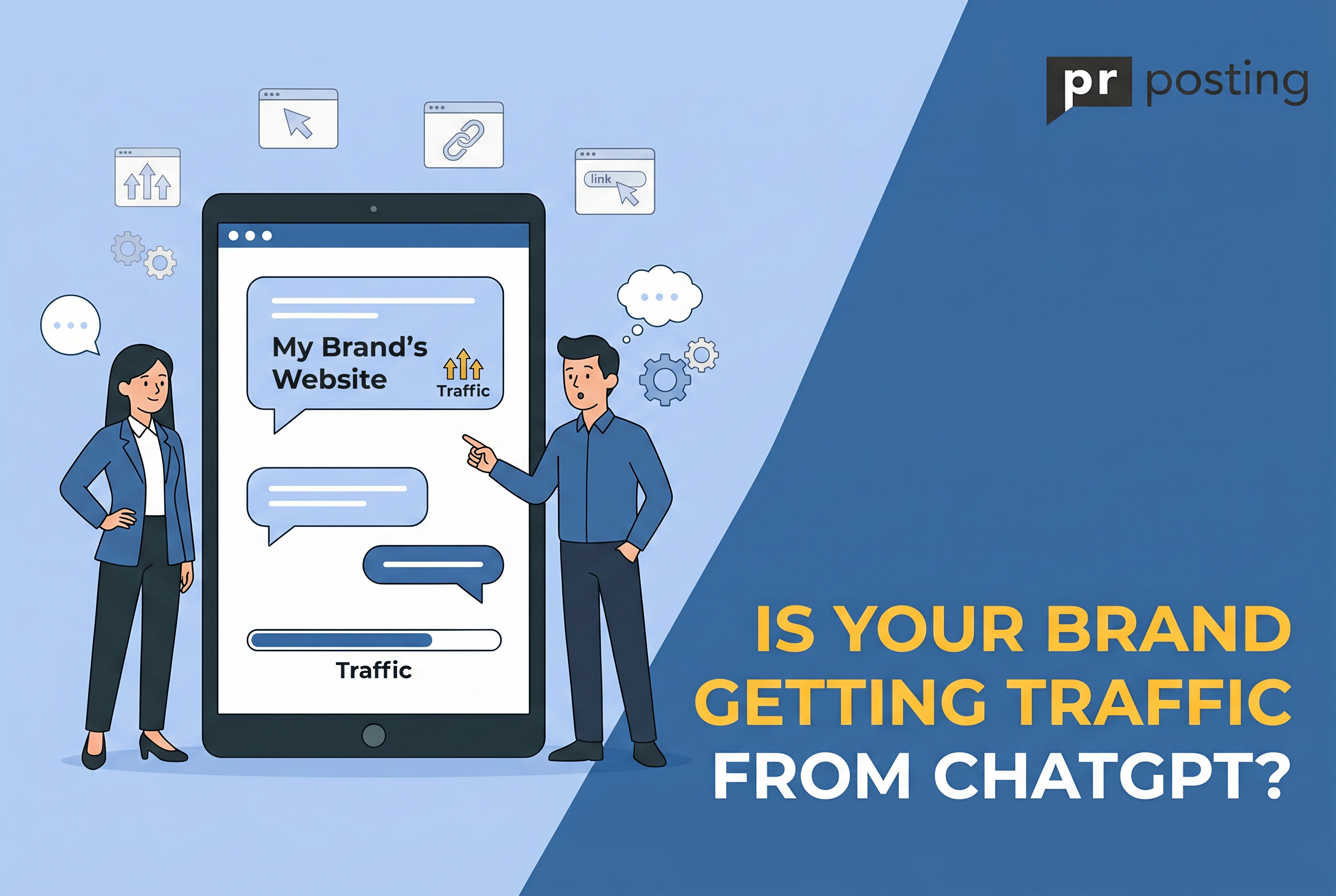
Unlike traditional organic search, this traffic flow is based on entity authority and clear citation signals.
To attract traffic from ChatGPT, brands need to optimize their websites for search engines and maintain authoritative backlinks.
Key Takeaways
- Verify GPTBot Access. Make sure your robots.txt file gives OpenAI the necessary permissions to run the web crawler.
- Implement Schema Markup. Use Organization and Product schema to define your entities clearly.
- Monitor GA4 Weekly. Build custom segments to isolate ChatGPT.com and Perplexity.ai referrals.
- Focus on Citation-Worthy Links. Safe placement on reputable sites frequently visited by AI agents.
What is Traffic from ChatGPT?
Referral traffic from ChatGPT represents the visitors who click on hyperlinked “Sources” or “Citations” within an AI’s conversational response.
The traffic from ChatGPT is classified as a referral because it originates from an external application rather than a standard search engine results page.
Users clicking citations in AI chats generate this specific referral stream. It signals that an LLM has selected your site as a verified, authoritative data source.
If reputable sites link to your domain, ChatGPT is more likely to cite your URL as a definitive answer. This creates a virtuous cycle of authority.
How to Measure and Analyze Traffic from ChatGPT
To track traffic from ChatGPT, you need to configure Google Analytics 4 to identify specific hostnames used by AI platforms.
Currently, most AI-generated traffic comes through referrals, but identifying specific bots requires custom session filtering.
Many SEOs wonder how to see traffic from ChatGPT and Perplexity alongside traditional channels.
Use GA4 custom segments to isolate traffic from ChatGPT.com and other AI agents. This data helps marketers quantify their presence in AI-generated responses and AI overviews.
A famous case involved Vercel, which saw 10% traffic from ChatGPT, Perplexity, and Claude, showing that developer brands are early winners in this space.
Tools to monitor brand traffic from ChatGPT 2026 now include dedicated AI visibility dashboards.
These platforms track how often your brand appears in LLM responses.
Current data suggests that AI referrals can have a 25% higher conversion rate due to the pre-filtered nature of a user’s query.
Comparative Analysis of AI Referral Sources and User Intent
| AI Platform | Source in GA4 | Primary User Intent |
| ChatGPT / SearchGPT | chatgpt.com | Informational / Transactional |
| Perplexity AI | perplexity.ai | Deep Research |
| Claude | anthropic.com | Technical / Coding |
If you want to know how to get traffic from ChatGPT, focus on becoming a “named entity” within your niche.
LLMs prioritize websites that appear frequently in training data and real-time search indexes.
Secure mentions in high-quality publications and academic journals to influence AI training sets.
Citations on platforms like Reddit and TechCrunch act as primary trust signals for LLMs.
To track traffic from ChatGPT success, you must first be “visible” to the model. This requires clear, structured data and a presence on trusted secondary sites.
Recent findings on Reddit’s r/SEO suggest that natural language mentions in community threads often trigger ChatGPT citations. This is social seeding at work.
You must remain discoverable. Ensure your content uses short, declarative sentences. The AI needs facts to quote.
How to See Traffic from ChatGPT and Perplexity
To see traffic from ChatGPT and Perplexity, you must analyze the referral path in your web analytics.
Unlike traditional search traffic, these visits are categorized under the referral channel in Google Analytics 4 (GA4).
Monitoring these specific sources allows you to quantify the commercial value of AI citations.
Tracking AI referrals requires filtering GA4 for specific hostnames like ChatGPT.com. This data reveals how many users click through from AI conversational summaries to your website.
To check traffic from ChatGPT, navigate to the Traffic Acquisition report. Use a session source filter for “ChatGPT.com” or “Perplexity.ai.”
Tools to Monitor Brand Traffic from ChatGPT 2026
The tools to monitor brand traffic from ChatGPT 2026 center on deep referral analysis and native publisher insights.
Using these platforms helps you measure and analyze traffic from ChatGPT to justify your LLM optimization spend.
GA4 remains the standard for referral tracking, while Vercel and SearchGPT provide deeper technical and click-through data.
These tools help you map the journey from an AI chat to a site conversion.
- GA4 (Google Analytics). The gold standard for identifying ChatGPT.com referrers. Use it to track traffic from ChatGPT in real-time.
- Vercel Analytics. Popular among developers.
- SearchGPT. OpenAI’s native tool. Use it to see exact click-through rates on your citations.
Case studies from ChatGPT search show that brands optimizing for entities see a 25% higher conversion rate from AI referrals.
This happens because the AI has already pre-checked your site for the user.
| Tool | Metric Tracked | Best For |
| GA4 | Referral Source | General Marketing |
| Vercel | AI Agent Sessions | Technical Performance |
| SearchGPT | Citation CTR | Content Strategy |
How to Track Traffic from ChatGPT
To track traffic from ChatGPT, you need to configure Google Analytics 4 to highlight specific referrer URLs, such as ChatGPT.com.
This process involves identifying the referral source, accounting for dark AI traffic, and analyzing behavioral metrics.
ChatGPT users often display higher engagement times because the AI has already pre-qualified the content as a relevant source of truth.
Measuring AI-driven visits requires filtering GA4 for the ChatGPT.com hostname.
Marketers should also monitor direct traffic spikes and engagement metrics to capture the full scope of invisible AI citations.
Step 1: Identify the Referral Source
- In GA4, go to Reports.
- Select Acquisition.
- Click Traffic Acquisition.
- Filter the “Session source/medium” by referral traffic from ChatGPT. This filter reveals users who clicked a direct citation link.
A 2025 study by Search Engine Land found that AI-driven referrals increased by 527% for sites appearing in SearchGPT beta.
You must separate them from standard Google organic visits.
Step 2: Account for “Dark AI Traffic”
Many users of AI-powered apps don’t pass the referrer ID string. This creates “hidden AI traffic.”
Check for sudden spikes in “direct” traffic to specific long-tail blog posts. This often happens to pages that don’t rank high in Google search results.
This is likely invisible traffic from ChatGPT.
Step 3: Analyze User Behavior
Compare the “Average Engagement Time” of ChatGPT users against Google users. Typically, ChatGPT visitors stay longer.
The AI summary has already answered their basic question. They visit your site for deep expertise.
An expert from r/SEO noted that AI traffic has a 20% lower bounce rate than traditional search.
Comparative Analysis of AI Referral Sources and User Intent
| Metric | Google Search | ChatGPT Referral |
| Bounce Rate | Higher | Lower |
| Engagement Time | Average | High |
| Intent Level | Discovery | Deep Dive |
Common Mistakes to Avoid
The most frequent error in AI optimization is blocking the very crawlers that drive citations.
Many marketers also focus on “spinning” content rather than providing original Information Gain.
To track traffic from ChatGPT effectively, you must avoid these common pitfalls that cause domains to be skipped by AI agents.
Avoid GPTBot blocking and focus on valuable, original ideas to get citations.
Expanding your topic area by incorporating Perplexity is important, as its interface is specifically designed to encourage users to click on links.
- Blocking GPTBot. Blocking the crawler in robots.txt stops AI traffic entirely. Ensure your site is accessible to OpenAI’s agents to remain in the “Source” pool.
- Thin Content. AI will not cite content that merely summarizes other sources. It seeks unique data. A 2026 report found that ChatGPT only cites 15% of the pages it retrieves, ignoring the rest.
- Ignoring Perplexity. Perplexity often sends more traffic than ChatGPT per interaction. Its UI is built around citations. Perplexity users are often senior leaders, with 30% holding leadership roles.
AI Platform Conversion Rates
| Platform | Conversion Rate | Notable Feature |
| ChatGPT | 14.2%–15.9% | Dominant Referral Volume |
| Perplexity | 10.5% | Senior Leadership Audience |
| Google Organic | 1.76% | Highest Total Volume |
Google’s organic traffic still generates the most visitors. Its conversion rate lags because it attracts everyone at the initial stage of search.
These users are often simply browsing the site or looking for quick information.
Now, let’s look at artificial intelligence. Platforms like Claude, ChatGPT, and Perplexity serve as filters. They do the hard work first.
By the time someone clicks a link in an AI-powered chat, the bot has already answered their basic questions and confirmed their interest. You get a lot of highly engaged visitors.
This provides a conversion rate approximately five to eight times higher than standard search.
AI certainly generates less traffic. But this traffic actually leads to purchases. This is a shift from quantity to pure quality.
FAQ
Is referral traffic from ChatGPT reliable?
Yes. It represents a user actively seeking more depth after an AI summary.
How to see traffic from ChatGPT and Perplexity?
Use custom UTM parameters in your links if you provide data to AI partners. It makes tracking easier.
How to get traffic from ChatGPT consistently?
Secure links on high-authority wikis and news sites. GPTBot prioritizes these for real-time citations.
Can I see SearchGPT traffic in Google Search Console?
No. It currently appears in GA4 as referral traffic from ChatGPT.com.
How to get traffic from ChatGPT for a new brand?
Secure mentions on high-authority wikis and news outlets that GPTBot crawls frequently.
Is referral traffic from ChatGPT different from Google?
Yes. It is usually more specific and arrives after an AI has summarized your content.
How to track traffic from ChatGPT if it shows as Direct?
Check for sudden spikes in traffic to deep, non-ranking pages. Use custom GA4 segments for known AI hostnames.
How to get traffic from ChatGPT for B2B?
Focus on appearing in “Best of” lists and technical forums. AI agents frequent these websites for recommendations.



More Like This
How AI Content Score Affects Link Building Success