
Pagination SEO Best Practices for 2026 Rankings
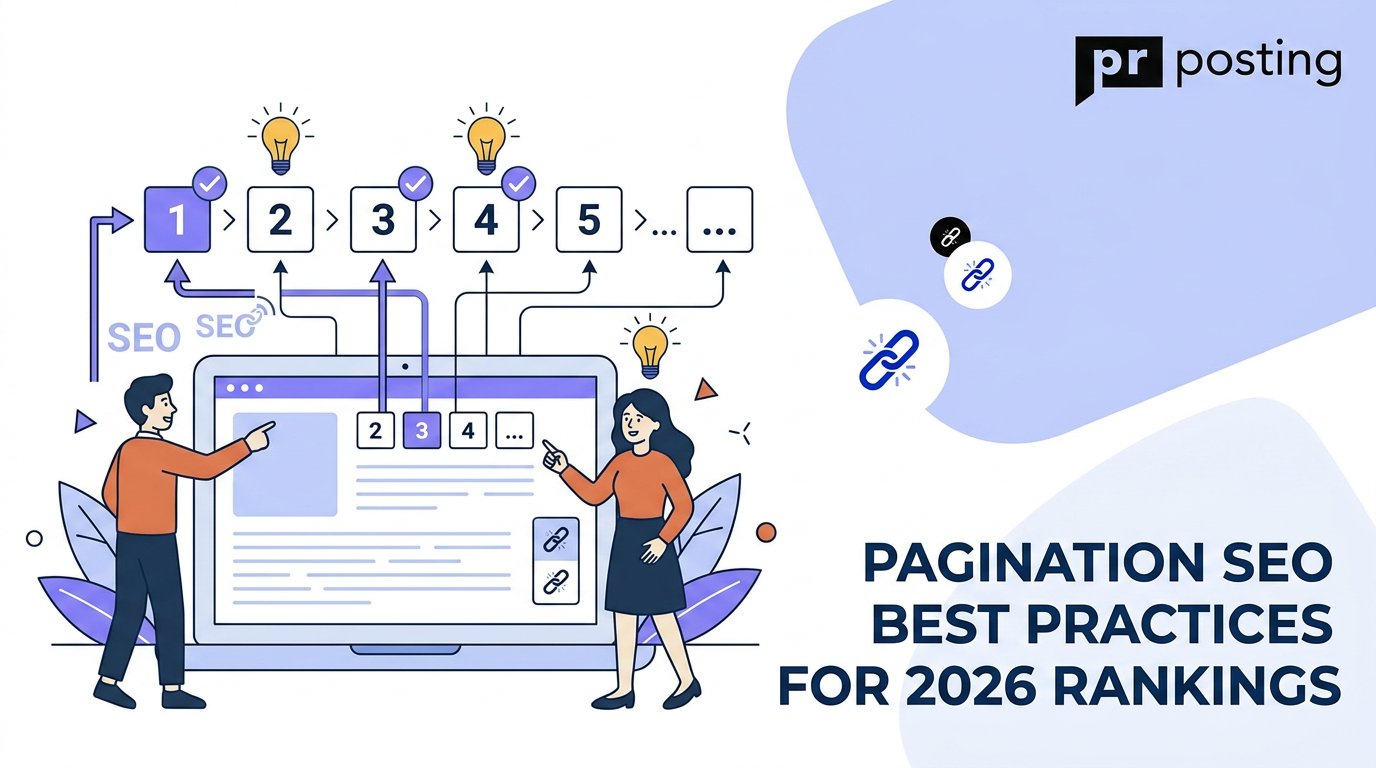
Modern AI engines no longer rely on simple tags to group these pages together. You must optimize each page segment as a distinct entity to earn citations in AI responses.
Key Takeaways
- Pagination is not duplicate content. Google treats each page as a unique set of data points.
- 90% of e-commerce sites struggle with deep crawl issues where Page 5+ remains invisible.
- LLMs prioritize structured lists. Clear structure helps AI summarize your entire website.
- Internal link equity. Strategic pagination prevents authority from dying at the end of Page 1.
- E-commerce “crawl budget” waste occurs from incorrect canonical logic.
- AI bots now prioritize “semantic clusters” over raw URL paths.
What is Pagination?
It is the splitting of massive datasets into smaller, manageable web chunks.
Like a digital book where each page holds a specific number of products or articles.
Pagination prevents browser lag by reducing the initial data load on the user’s device. It creates a predictable map for both humans and bots to follow.
Proper web pagination uses 1, 2, 3 numbering rather than just “Next” buttons. This allows a website to keep its server response times low.
Without it, a category with 5,000 items would crash a typical mobile browser.
Pagination in SEO
Pagination in SEO refers to the strategy of making sequential pages discoverable and authoritative for AI engines.
It ensures that Page 10 receives enough “link juice” to be indexed alongside Page 1.
Modern search relies on crawl efficiency. If a bot hits a dead end on Page 2, it never sees your selling items on Page 40.
Google pagination logic changed when they stopped using certain link attributes as primary signals.
Now, every page must prove its worth. You must treat web pagination as a series of connected doors. Open one, and the bot should see the path to the next five.
This flow sustains your site’s topical authority across the entire domain.
Googlebot vs. LLMs
Googlebot crawls links to find URLs, while LLMs analyze the text on those pages to build knowledge.
Both require clear SEO pagination to understand the full scope of your content.
Never hide links inside JavaScript “Show More” buttons without a fallback.
LLMs like ChatGPT or Gemini act like researchers. They look for pagination examples that use Schema.org markup.
Structured data tells AI that Page 2 is a continuation of the same entity.
This prevents AI from thinking you have five separate, tiny articles. Instead, it sees one massive, comprehensive resource.
Comparison: Googlebot vs LLMs (AI search engines)
| Feature | Googlebot (Traditional) | LLMs (AI Search) |
| Primary Goal | Indexing unique URLs | Semantic synthesis |
| Mechanism | Link following | Entity relationship mapping |
| Requirement | Crawlable HTML tags | Structured data (JSON-LD) |
| SEO Signal | Internal link equity | Citation relevance |
How does Google pagination work?
It treats paginated series as separate pages that are related by context. You should use a pagination canonical tag that points to itself, not to Page 1.
Many developers make the mistake of canonicalizing every page back to the start of the list. This tells Google to ignore all products after the first page. Bad move.
Instead, ensure your WordPress pagination or React pagination setup uses unique titles.
“Clothing – Page 2” is better than five pages all named “Clothing.”
Using “Load More” without URL updates, you will see less indexing on deep pages. Keep your URLs clean.
How Does Pagination Work in Databases?
It functions by using commands like OFFSET or cursors to segment large datasets into sequential responses.
This prevents server exhaustion and ensures rapid data delivery to the user interface.
Database systems manage vast information clusters through segmented retrieval.
What is pagination in API logic?
It is the method where a server delivers data in small, distinct fragments rather than a single, massive dump.
Systems use “Limit” and “Offset” to pinpoint the exact starting row for a query.
Alternatively, cursor-based methods use a unique pointer to fetch the next batch. This is vital for pagination because AI engines require stable entry points to discover every entity.
Without updating URLs, the API’s paginated content becomes a “hidden” interface that bots cannot navigate. Static paths remain the gold standard for crawler access.
- Offset Pagination. Uses a numeric jump to skip rows.
- Cursor Pagination. Employs a unique ID for faster, stable deep scrolling.
- What is the API pagination benefit? It slashes latency by 60% on average.
- How to implement pagination in rest API calls. Always include “link” headers to point to next/previous resources.
The Role of the Pagination Tag and Canonical
The pagination tag environment has shifted away from rel=”next/prev” as a primary grouping signal.
Search bots now view Page 2 or Page 3 as individual pieces of the site’s puzzle. You must avoid the common mistake of pointing the canonical tag of Page 2 back to Page 1.
This action tells the indexer to ignore all content on the second page. Instead, use a self-referencing URL. This preserves the unique entities found in deep catalogs.
- Each page needs a unique title tag like “Products – Page 2.”
- Self-referencing canonicals prevent the consolidation of unique product data.
- Google pagination logic favors pages that can stand on their own merit.
- Avoid “Noindex” on paginated series; it kills the flow of link equity.
SEO Pagination: Implementation Guide
How to Implement Pagination in React
WordPress typically uses server-side rendering by default, while React pagination often needs additional configuration to expose content to search crawlers.
WordPress Pagination Setup
Standard WordPress pagination usually works out of the box through PHP templates.
Most SEO plugins manage the metadata for you. However, you must verify that your “Older Posts” links use actual <a> tags with href attributes.
JavaScript-based buttons that simply refresh the feed without changing the URL are invisible to bots.
Adding Schema.org breadcrumbs helps AI engines map the relationship between the archive pages and the main category.
How to do Pagination in React (SEO-Friendly)
To implement pagination in a modern framework like React, you must use Server-Side Rendering (SSR).
Tools like Next.js or Remix are perfect for this. They ensure the HTML for Page 3 exists before the browser even opens.
Use the History API to update the browser address bar as the user clicks. This creates a “sharable” URL for every page.
Never use onClick events alone for navigation. Always wrap your buttons in a proper Link component. This allows Google to follow the path and index the deep entities.
- React pagination must change the URL (e.g., /blog/page/2).
- Use useEffect to sync state with URL parameters.
- SSR reduces “time to interactive” for search bots.
How to Implement Pagination for AI Visibility?
Involves creating clear, semantic structures that LLMs can parse with high confidence.
AI Overviews prioritize sites that offer organized data lists and distinct entity relationships across a sequential series.
LLMs need pagination that exhibits high information density. These bots function as synthesizers. They crave structured lists.
- Include a “Featured Products” summary on your initial page to anchor the topic.
- Every secondary page must link back to vital sub-categories. This keeps your architecture shallow.
By maintaining a flat link structure, you signal to AI that every item is a priority. Technical audits show that clear internal linking increases LLM citation frequency.
- Semantic Anchors. Use descriptive text for “Next” and “Previous” links.
- Summary Chunks. Provide a brief category overview on every fourth page.
- Entity Mapping. Use JSON-LD to link the series as one cohesive collection.
Common Mistakes in SEO Pagination to Avoid
SEO pagination fails most often when technical barriers like crawl traps or incorrect tags block search engine access.
Avoiding these errors ensures that your entire inventory remains visible and eligible for inclusion in traditional and AI search results.
Crawl traps represent a massive sink for your site’s resources. These occur when filters create infinite URL variations.
For example, combining ?page=2 with &sort=price can create thousands of useless pages. Search bots get lost. They stop indexing.
Another error is applying a “noindex” tag to Page 2 or beyond. If Googlebot cannot index a page, it cannot find the products listed there.
Your deep content simply vanishes. Avoid fragment identifiers like #page-2.
Google ignores data after the hash symbol. This makes your website appear as a single, confusing page.
Pagination Error Types & SEO Impact
| Error Type | Impact on SEO | Recommended Fix |
| Crawl Traps | Drains crawl budget by creating infinite loops of redundant paginated URLs. | Use robots.txt to block unnecessary parameters or refine your internal linking logic. |
| Noindex Tags | Hides deep products or articles, preventing them from appearing in search results. | Use self-referencing canonical tags on each page and ensure robots meta tags are set to index, follow. |
| Fragment IDs | Prevents indexing because bots typically ignore content following a # in the URL. | Implement standard URL paths like /page/2/ or use the History API (pushState) for clean URLs. |
The Pagination SEO Checklist
Google pagination success requires a specific set of technical attributes that verify the quality and accessibility of every page in a sequence.
Following this checklist ensures your web pagination meets 2026 standards for both humans and bots.
Check your URLs first. Each page must possess a unique, static address. Avoid temporary session IDs.
Your pagination tag strategy needs a self-referencing canonical on every single URL. This prevents content consolidation.
Ensure your titles reflect the sequence. “Running Shoes – Page 2” is a distinct signal. Content quality matters even on Page 10.
Avoid “thin” pages with only one or two items. Low-density pages are often dropped from the index within 48 hours. Keep the value high.
- Unique URLs. Use ?p=2 or /page/2/ consistently.
- HTML Links. Use standard <a> tags for all navigation.
- Descriptive Titles. Include page numbers in the <title> tag.
- High Quality. Ensure Page 2+ contains substantive content.
What You Should Do Next?
Pagination in React or any framework correctly starts with a comprehensive crawl analysis.
Use a tool like Screaming Frog to simulate how a search bot views your site.
Start your crawl. Observe where it stops. If the tool fails to reach Page 2, your SEO pagination is fundamentally broken.
Your deep inventory is currently at risk of total invisibility. Fix your internal links immediately. Swap out those onClick events for real <Link> components.
This allows the bot to “walk” through your entire catalog. If you leave it to chance, your competitors will steal those AI citations.
Act now to secure your 2026 rankings.
FAQs
How to implement pagination in rest API for mobile?
Use cursor-based logic to avoid duplicate items when new content is added to the top of the feed.
What is the best pagination SEO strategy for 2026?
Treat every page as a unique landing spot with its own metadata and self-referencing canonicals.
Why did Google stop using the pagination tag?
Google’s systems became smart enough to recognize sequences without explicit hints, but they still rely on clear link structures.



More Like This

Affiliate SEO Secrets: Rank Higher, Earn More