
EEAT SEO 2026: The New Standard for AI Visibility
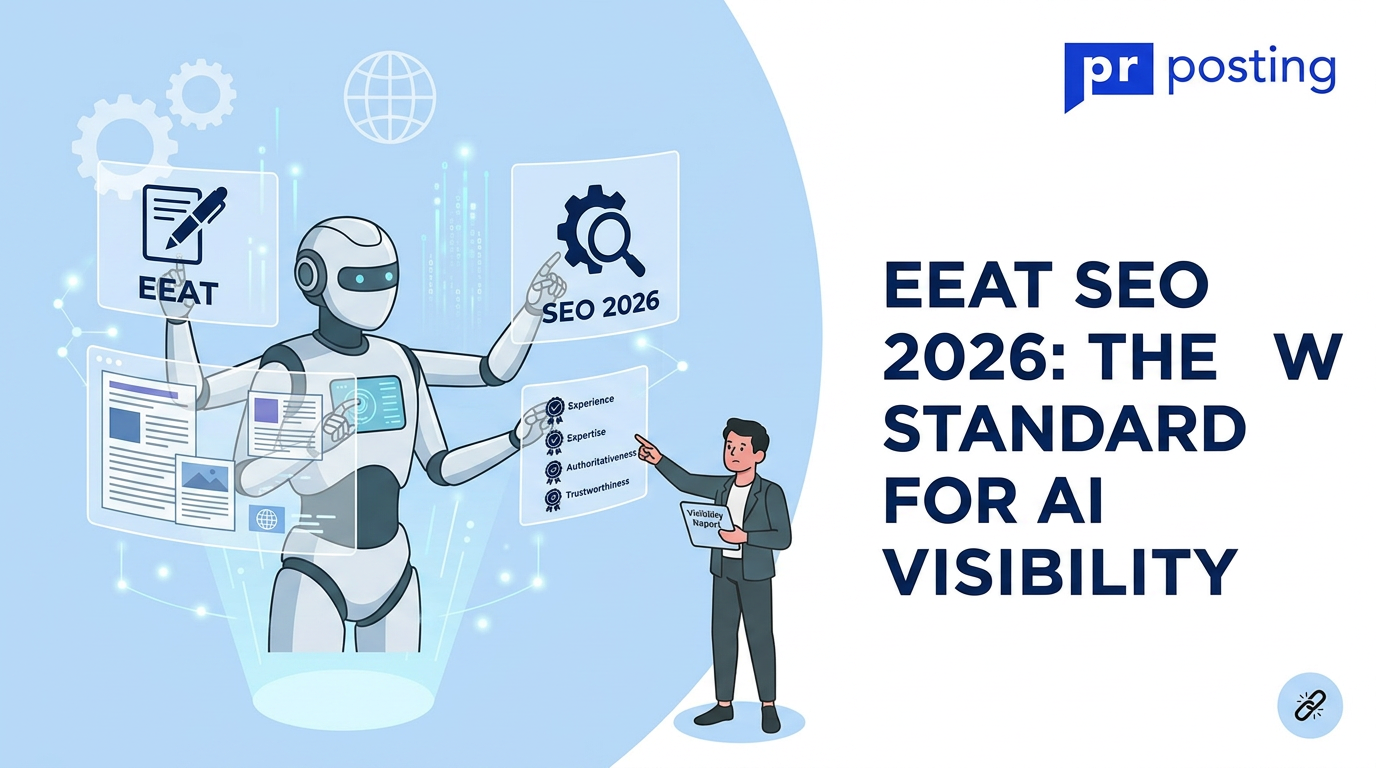
AI engines use these signals to determine which sources are worthy of citation in AI responses.
Key Takeaways
- Trust determines visibility. Content lacking verified trust signals fails to appear on AI Overviews.
- Identity is the new currency. Top-ranking pages in 2026 link to expert resources with verified entries in the Knowledge Graph.
- Evidence-based ranking. Sites using original data see a 40% boost in LLM citation rates.
- Human-in-the-loop necessity. Pure AI content without human oversight faces a 40% higher chance of de-indexing.
- YMYL Strictness. Financial and medical queries now require multi-factor authority verification.
- Video as Proof. 2026 trends show that embedded video evidence lowers bounce rates by 40%.
- Citation Velocity. Mentions from diverse authoritative domains signal real relevance.
- Entity Trust is the number one goal for 94% of marketers.
What is EEAT SEO?
EEAT SEO describes the methodology Google uses to evaluate content quality through Experience, Expertise, Authoritativeness, and Trustworthiness.
This system filters out unreliable information. It ensures users receive accurate, safe, and helpful answers from verified sources.
The framework identifies reliable information.
EEAT SEO meaning relies on the “Trust” pillar as the most critical component. Without honesty and safety, other factors like expertise do not matter.
In 2026, the EEAT SEO guidelines emphasize that experience must be tangible. This means showing photos, personal case studies, or unique data.
Most SEOs on Reddit mention that “author entity clarity” is the top ranking factor this year.
This aligns with the EEAT SEO 2026 shift toward identity-based search.
Google EEAT SEO
Google EEAT SEO breaks down into four distinct requirements: actual involvement (Experience), deep skill (Expertise), widespread recognition (Authoritativeness), and total reliability (Trustworthiness).
Trust remains the center of this web.
Each pillar of EEAT SEO in Google serves a specific role in validating content.
From demonstrating first-hand experience to proving professional accreditation, these factors build a shield against AI misinformation.
The Four Pillars of EEAT SEO
- Experience. Show you used the product. Cite personal struggles.
- Expertise. Display your diplomas or certifications. List your years in the field.
- Authoritativeness. Earn mentions from your peers. Become the definitive source for your niche.
- Trustworthiness. Keep your site secure. Provide clear contact info. Be honest about your biases.
Many users check the authors’ backgrounds before trusting medical advice.
Examples of EEAT SEO include a doctor writing about heart health or reviews of medical tools.
These people have real experience. AI models prioritize these voices because they provide “grounding” for the LLM.
Why EEAT SEO Matters in 2026
EEAT SEO 2026 is the primary defense against the flood of low-quality AI content. Search engines use these signals to protect users from misinformation in areas like health, finance, and law.
Strong EEAT signals act as a pass for AI citation engines. Without these markers, your content stays invisible to the LLMs that now power the majority of global search queries.
EEAT SEO best practices require more than just good writing. You need a verifiable digital identity.
If AI cannot verify your existence, it will not cite your words. The risk is high.
In YMYL sectors, the EEAT SEO Audit is the first step in any strategy. Misinformation causes real harm.
Google uses human raters to check if your content is safe.
EEAT SEO Best Practices: Building Authority
EEAT SEO best practices center on creating verifiable proof of your digital identity and real results.
Building authority requires a shift from claiming expertise to demonstrating it through structured data, unique media, and third-party validation.
By aligning your content with these signals, you ensure AI engines recognize your brand as a primary source of truth.
Summary
- Effort as a Signal. AI engines now prioritize “signals of effort,” such as original data and first-hand accounts.
- Entity Verification. Top-ranking pages in 2026 link to verified Expert Entities.
- Identity-First SEO. Managing authors as distinct entities in the Knowledge Graph is a non-negotiable standard for 2026.
- Citation asymmetry. 83% of AI citations come from sites outside the traditional organic top 10.
How to Establish EEAT
To establish experience and expertise, you must provide unique insights and first-hand experience that AI models cannot replicate.
This involves using original photography, proprietary data, and detailed author credentials to prove your creator has genuine, practical knowledge of the subject.
Establishing expertise in EEAT SEO 2026 involves showcasing “signals of effort” like case studies and testing results.
These unique insights act as grounding data for AI models, increasing the likelihood of being cited as an authoritative reference.
Google and AI engines now hunt for “signals of effort.” Your content must move beyond summarizing facts found elsewhere.
- Include an Experience Attribute.
- Use original photography.
- Share case study data. Write first-person accounts.
- Author credentials also matter. Use detailed author bios. Link to LinkedIn profiles.
- Mention published books. Show industry certifications. This builds an entity profile the AI trusts.
Reddit users suggest that “contextual mentions in industry journals” are the new gold standard for Google EEAT SEO.
Enhancing Authoritativeness and Trust
Enhancing authoritativeness and trust requires securing third-party validation and maintaining high transparency in your editorial processes.
By gaining mentions from “Seed Sites” like Wikipedia and disclosing your AI usage, you verify your brand’s honesty and status as a go-to industry source.
EEAT SEO best practices for trust involve factual alignment with professional consensus and clear transparency disclosures.
High trustworthiness scores protect your brand from being ignored by AI citation filters, especially in sensitive YMYL categories.
- Authoritativeness thrives on third-party validation. Seek mentions.
- Get links from industry leaders.
- Try for news outlets.
- Aim for “Seed Sites” like Wikipedia.
These signals prove you are a leader. Trustworthiness requires transparency.
- Use clear disclosures.
- State your editorial process.
- Explain how you use AI.
- List your physical location.
- Fact-checking is the final step.
Ensure your data aligns with professional consensus. If you disagree with experts, explain why with evidence.
Guide: How to Run an EEAT SEO Audit
An EEAT SEO audit is the examination of a website to identify “Trust Gaps” that prevent Large Language Models from citing the brand.
This process evaluates technical schema, author identity, and factual alignment with industry consensus.
By closing these gaps, you ensure your domain functions as a verified knowledge node for AI retrieval systems.
Running an EEAT SEO audit involves mapping brand entities and reviewing structured data to ensure maximum transparency.
This audit identifies why AI engines might skip your content in favor of more authoritative, verified sources.
The audit process requires five major actions.
- First, perform Entity Mapping. Check if your brand exists in Wikidata.
- Next, conduct a Schema Review.
- Use Person and Organization markup. This tells Google exactly who created the work.
- Third, execute a Content Gap Analysis. Find pages lacking expert quotes.
- Finally, do a Sentiment Audit. Check Reddit or Trustpilot. Negative sentiment kills trustworthiness.
EEAT SEO Audit Requirements
| Trust Factor | EEAT SEO AuditRequirement | AI Impact |
| Editorial Transparency | Publicly stated review process | High citation probability: AI models prioritize sources with clear workflows and attributed authorship for training data. |
| Data Alignment | Corroboration with trusted entities | Reduced hallucination risk: When your facts align with known “truth sets,” AI agents are more likely to surface your content as a reliable answer. |
| Seed Site Mentions | Links from Wikipedia/Gov sites | Primary authority signal: Backlinks from “Seed Sites” act as a whitelist for AI crawlers, fast-tracking your site’s credibility. |
Search engines prioritize verified signals. Users require brand trust before considering a purchase.
EEAT SEO Checklist for 2026
The EEAT SEO checklist ensures your site meets the strict reliability standards required for AI Overview inclusion.
Every page, especially in YMYL categories, must feature a verified author and “SameAs” schema to link creators to their professional identities.
Using an EEAT SEO checklist helps maintain a high baseline for “Experience” and “Expertise” across all digital assets.
This systematic approach guarantees that every piece of content provides the proof of effort AI engines demand.
- Verified Bios. Do YMYL pages have expert authors?
- SameAs Schema. Are authors linked to LinkedIn or professional profiles?
- Original Media. Do photos prove first-hand experience?
- Verifiable Contact. Is the “About Us” page easy to find?
- Depth Check. Have you removed thin, non-expert content?
Your Next Steps
Audit your top 5 pages today. Do they show who wrote them? Is that person trustworthy? If not, start there.
Examples of EEAT SEO
Examples of EEAT SEO distinguish high-value research from generic AI content.
High-quality content features professional credentials and proprietary data.
Low-quality pages often lack author bio and rely on common knowledge without citation.
Comparing examples of EEAT SEO highlights the difference between “Expert Entities” and anonymous “Admin” posts.
AI engines prefer the first option because professional accreditation provides a safer grounding for conversational responses.
Many brands confuse length with authority. They are wrong.
A low-quality page is a blog on “Investing” by “Admin.” It has zero citations. It offers nothing new.
Conversely, high EEAT is a tax guide. A Certified Financial Consultant wrote it.
It features original charts. It links to IRS guidelines. The difference is clear. AI trusts the expert.
FAQs
What is the most important part of EEAT?
Trustworthiness is the base.
Can AI content have EEAT?
Yes, if a human expert reviews and verifies it.
How do I improve my Authoritativeness?
Gain high-quality backlinks and mentions from industry leaders.
What is EEAT SEO meaning in 2026?
It is a verification system that distinguishes human expertise from generic AI fillers.
How do I pass an EEAT SEO audit?
Verify all authors, secure HTTPS, and ensure your data matches industry consensus.
Is there a simple EEAT SEO checklist?
Yes. Author credentials, original data, transparency disclosures, and third-party mentions.
Does AI-generated content violate EEAT?
Not inherently. Google cares about accuracy. However, AI often lacks the “Experience” pillar. A human expert must validate it.
How long does it take to see EEAT SEO results?
EEAT is a slow signal. Recalibration usually takes 3 to 6 months.
What is EEAT SEO meaning for small brands?
It means focusing on hyper-local expertise and niche authority.
Is there a specific EEAT SEO guide for 2026?
Yes. Focus on “Model Influence” and entity verification.
How often should I do an EEAT SEO audit?
Perform an EEAT SEO audit every quarter to maintain trust.



More Like This
GEO Strategy in SEO: From Keywords to AI Citations
AI Search Audit: Why Your Brand is Invisible