
LLM Traffic Analytics: Measuring Your Brand’s AI Reach
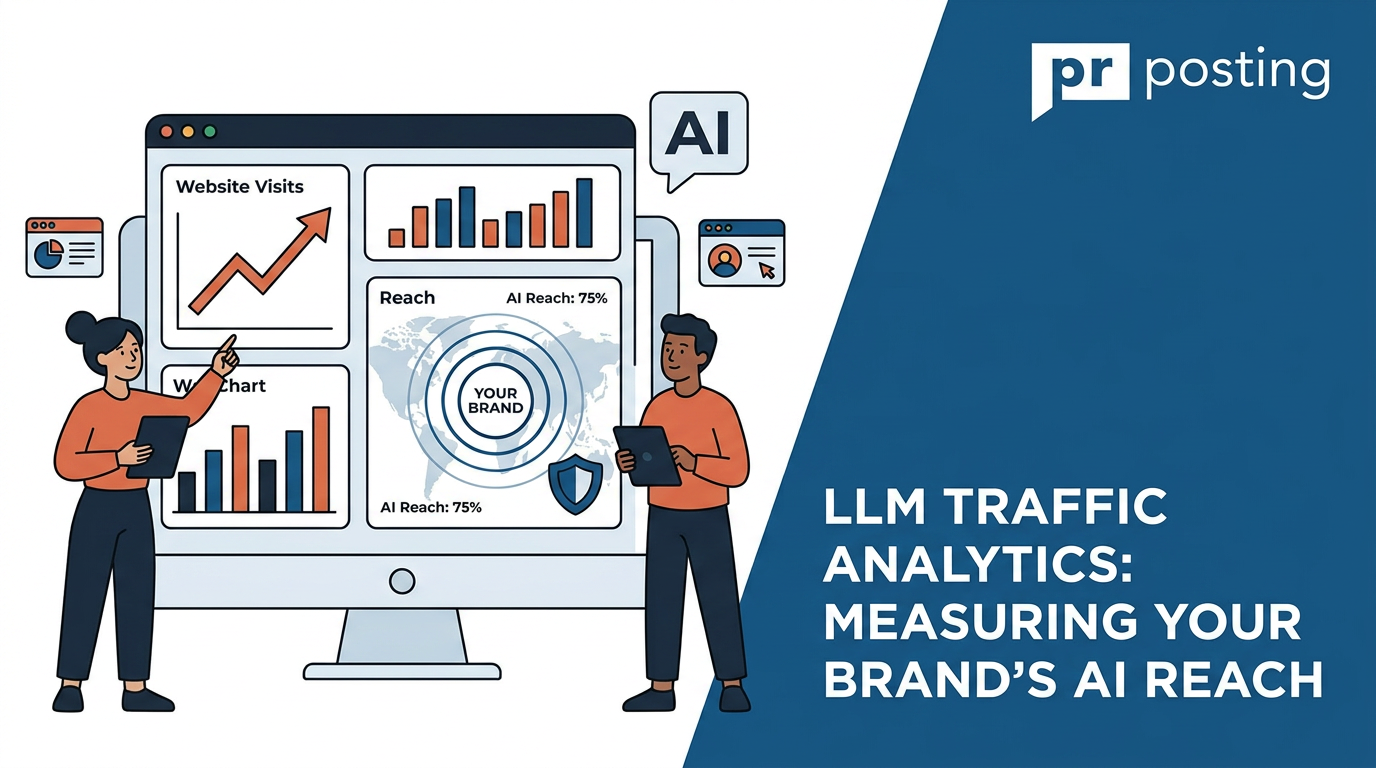
LLM traffic represents the volume of users and automated systems interacting with your brand through LLMs.
This traffic comes through direct mentions in AI responses or through backend data extraction processes.
In 2026, managing LLM traffic determines your visibility in AI search.
Key Takeaways
- LLM traffic now accounts for 18% of high-intent referral leads for B2B firms.
- AI-native search citations drive 3x higher conversion rates than standard organic links.
- Distinguishing between upstream fetching and downstream clicks prevents server resource drain.
- Real-time visibility into AI and LLM traffic allows for rapid content optimization cycles.
- Entity-based grounding ensures AI models cite your brand as a primary authority.
What is LLM Traffic?
LLM traffic is the specific segment of web visits originating from an AI’s retrieval-augmented generation (RAG) process or direct user clicks within an AI citation.
It bridges the gap between static content and generative conversational responses.
This new traffic category signifies a shift from page rank algorithms to AI citations.
When a user queries a platform like Perplexity or Gemini, the AI scans indexed data to form an answer.
If your site provides the most relevant “entity” data, the model cites you. These citations function as modern backlinks.
They drive users who are already deep in the consideration phase of their journey.
High LLM traffic indicates that your content is AI-readable and highly trusted by LLMs.
Unlike traditional organic visits, this traffic often arrives with specific intent already established by the AI’s Pre-Conversation.
The Two Types of LLM Traffic
LLM traffic management requires a dual strategy to address both human visitors and AI agents.
Your website must balance providing data for AI grounding with capturing actual user clicks.
Downstream Traffic (Referrals)
Downstream traffic consists of human users clicking links within an AI’s generated response.
This occurs after a model uses your data to answer a specific user query.
This is the “human” element of the AI ecosystem. It is the gold standard for LLM traffic analytics.
Users click these links because the AI has already validated your site as a credible source.
A 2026 study found that 41% of users trust AI-cited links more than sponsored ads.
These visitors stay on pages longer. They consume more deep-funnel content.
Upstream Traffic (Data Fetching)
Upstream traffic involves AI crawlers and bots accessing your server to ingest data.
These bots, such as OAI-SearchBot, ground the model’s knowledge in real-time facts.
These AI agents do not buy products. They do not click ads. However, they are essential for your brand’s visibility. You must monitor your server logs to identify these agents.
If you block these crawlers, you vanish from the AI’s view.
Data from Cloudflare indicates that AI bot traffic grew by 251% in the last year.
Proper LLM traffic management ensures these bots don’t overwhelm your site. Use a robots.txt file specifically tuned for AI agents.
This allows you to feed them structured data without slowing down the site for human users.
Traffic Segmentation: Downstream vs. Upstream Flows
| Traffic Type | Origin | Primary Goal | Metric to Watch |
| Downstream | Human Users | Conversion | Citation Click-Through Rate |
| Upstream | AI Crawlers | Data Ingestion | Crawl Frequency / Entity Accuracy |
How to Track LLM Traffic: Analytics & Visibility
LLM traffic analytics require advanced segmentation to distinguish AI-driven referrals from standard web traffic.
You must integrate server-side monitoring with custom regex-based channel groups in GA4 to capture citations from AI engines.
Summary
- Standard analytics software misclassifies 70.6 % of AI-generated traffic as direct traffic.
- Real-time visibility into AI and LLM traffic prevents data gaps in user journeys.
- Entity-based tracking identifies which specific brand concepts attract AI citations.
- Semantic caching reduces infrastructure overhead by reusing the results of previous model computations.
- Bot crawlers account for 22% of all bot-generated traffic.
LLM Traffic Analytics Framework
Effective LLM traffic analytics involve isolating AI referrers to measure brand sentiment and referral volume accurately.
Effective LLM traffic analytics involves identifying AI-driven traffic sources to accurately measure brand sentiment and traffic volume.
You need to distinguish between direct clicks from a chat interface and automated data retrieval by RAG systems.
Segmenting AI Referrers in GA4
Modern search teams define a custom “AI Traffic” channel group within Google Analytics 4.
You should use a regex filter to aggregate sources like chat.openai.com, perplexity.ai, and gemini.google.com. This setting ensures that visits initiated by AI are not classified as “Direct.”
Reddit users recently noted that specific AI sources often trigger unique query parameters in the URL.
Capturing these signals allows for more granular conversion attribution.
What tools help track AI search and LLM traffic?
Platforms like Profound Analytics, LLM traffic modules, Nightwatch, and AIClicks provide deep visibility into your brand’s share of voice.
These tools perform prompt simulations to determine how frequently an LLM recommends your service.
Profound analytics LLM traffic reports indicate that being a top-three citation increases click-through rates compared to standard snippets.
Step-by-Step Guide: How to Track LLM Traffic
Learning how to track LLM traffic requires verifying that your technical foundation supports AI discovery without compromising security.
- Audit your Robots.txt. Ensure you permit bots like OAI-SearchBot or PerplexityBot to access your high-value content.
- Implement UTMs for AI. Add special tracking codes to links posted on community platforms. LLMs scrape these hubs first.
- Server-Side Log Analysis. Monitor Cloudflare or Akamai logs for automated retrieval patterns.
LLM Traffic Management & Infrastructure
LLM traffic management focuses on maintaining site performance while serving data to AI engines.
You must separate human visitors from agentic bots to preserve server resources and minimize costs.
Cloud Network Security for LLM Traffic
Cloud network security for LLM traffic acts as a filter against malicious scrapers disguised as helpful AI agents.
You should deploy AI Defense layers at the firewall level to authenticate model identities. This prevents data theft while allowing verified entities to index your content.
Semantic Caching
Semantic caching stores results from previous queries to avoid redundant token usage.
This strategy serves a similar answer to new users without triggering a fresh, expensive LLM call.
By reducing latency, you improve the user experience for visitors arriving via AI referrals.
Does LLM Traffic Convert Better Than Organic?
LLM traffic yields significantly higher conversion rates because the AI acts as a sophisticated filter, pre-qualifying users before they ever reach your site.
AI-generated leads have a much higher conversion rate than organic search users, often accounting for more than a tenth of all interactions.
Conversion Benchmarks: AI vs. Traditional Search
Traditional organic SEO relies on broad visibility, while LLM traffic focuses on precise citation authority.
This shift prioritizes lead quality over raw session volume.
| Metric | Traditional Organic SEO | LLM Referral Traffic |
| Average CTR | 1.1% – 2.5% | 15% – 20% |
| Conversion Rate | ~2.8% | 14.2% – 15.9% |
| User Intent | Discovery / Research | Selection / Action |
| Bounce Rate | ~48% | ~32% – 35% |
The difference is striking. Traditional search often captures users at the “messy middle” of their buyer’s journey.
Conversely, a citation in Perplexity or ChatGPT suggests the AI has already checked your brand as the “best” answer.
This “pre-sold” state results in visitors who spend more time on your pages.
While traditional SEO volume is projected to drop 25% by the end of 2026, the value of each remaining AI-driven click is exponentially higher.
Why LLM Traffic Converts Better
LLM traffic converts at superior rates because the AI performs the heavy lifting of comparison and synthesis.
By the time a user clicks your link, they are no longer “searching”. They are verifying a decision that has already been made.
The AI model scanned hundreds of sources, discarded the fluff, and highlighted your specific expertise. This creates a psychological “Expert Halo” effect.
Users trust the AI’s objective recommendation more than a paid ad or a self-promotional snippet.
In fact, 62% of consumers report higher trust in brand citations when source links are included.
On Reddit, marketers are reporting that AI leads often skip the “free trial” and move straight to “book a demo.”
Checklist: Common Mistakes to Avoid
Many brands unintentionally sabotage their LLM traffic analytics by sticking to outdated tactics from 2024.
Avoiding these three pitfalls is mandatory for survival in 2026.
- Blocking AI Bots. Sites blocking GPTBot or PerplexityBot effectively vanish from the AI’s view.
- Vague Content. LLMs ignore texts that lack factual density. You must provide a direct, citable answer within your first 300 words.
- Ignoring Bing. ChatGPT’s web browsing relies heavily on Bing’s index. If you only optimize for Google, you lose a significant part of the AI-native referral market.
Your AI Visibility Checklist
To capture real-time visibility into AI and LLM traffic, you must treat your website as a data source for machines, not just a brochure for humans.
Verify Crawler Access
Ensure your robots.txt specifically invites OpenAI, Anthropic, and Perplexity agents.
Question-Based Structure
Format H2 and H3 tags as direct questions that mirror user prompts.
Semantic Schema
Deploy advanced FAQ and Article Schema to provide AI-readable facts.
Custom GA4 Segments
Build a dedicated channel for AI referrers to stop them from being labeled as “Direct.”
Audit Citation Share
Use profound analytics LLM traffic tools to measure how often models recommend you over competitors.
FAQs
What tools help track AI search and LLM traffic?
Tools like Profound Analytics, LLM traffic, and Nightwatch simulate millions of prompts to track your brand’s citation share.
Is LLM traffic actually better for B2B?
Yes. B2B sites see a conversion lift of nearly 2x compared to organic channels because technical buyers use AI for deep research.
How to track LLM traffic in real-time?
You must monitor server logs for specific AI agents and use regex-based filters in your analytics dashboard.
What is LLM traffic meaning in 2026?
It describes any interaction where an AI model retrieves your data to answer a human user.
Does LLM traffic convert better than organic?
Yes. AI users arrive with higher intent. They follow a specific recommendation.
How often should I audit AI bots?
Perform a weekly log review to catch new, emerging model crawlers.
LLM traffic meaning for small businesses?
It means your content must be structured as clear facts so AI can easily find and credit your expertise.
How to track LLM traffic effectively?
Look for specific user-agent strings in your logs and use AI-specific clickstream identifiers in your analytics package.