

Why AI Content Chunking Matters for Link Building
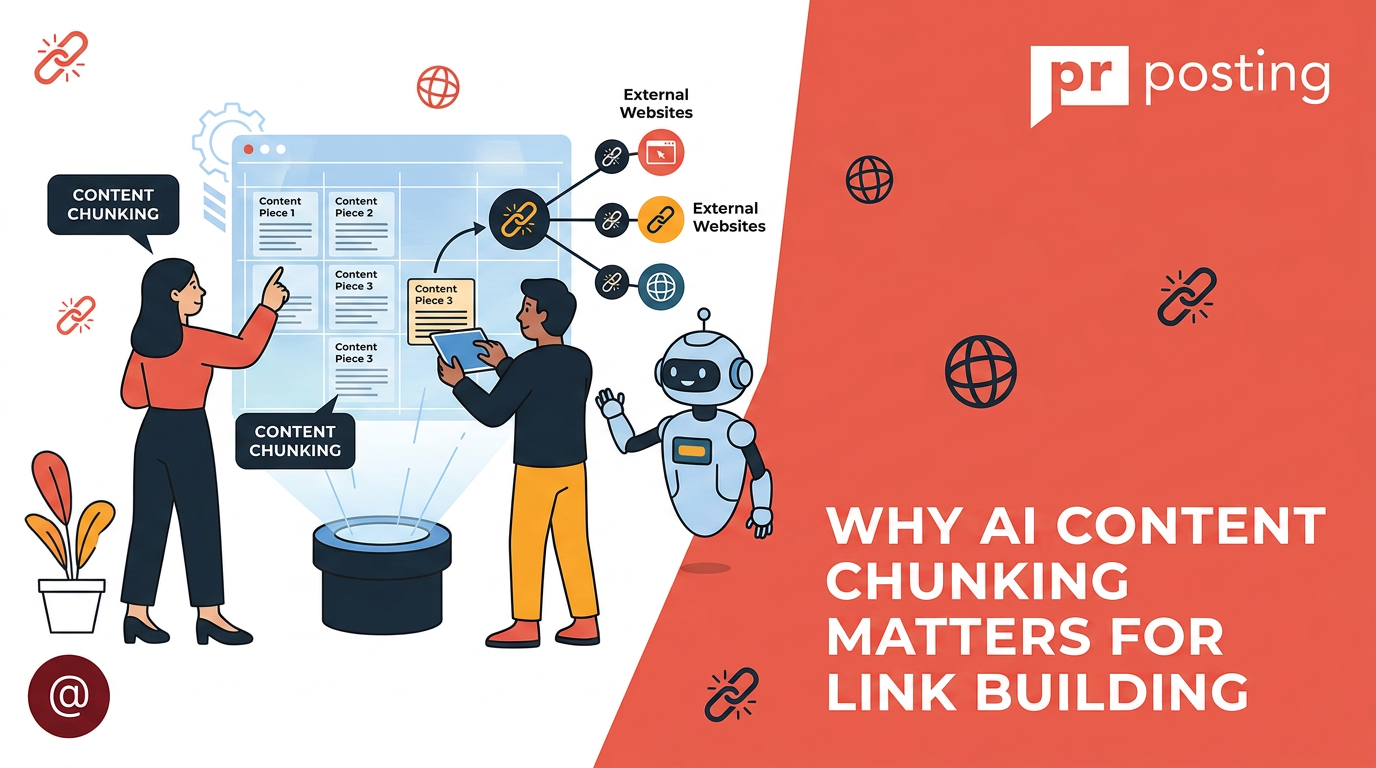
By dividing information into semantically independent units, you increase the likelihood of your site becoming a primary data source for AI Overviews.
Key Takeaways
- AI content chunking boosts citation probability in RAG-based systems.
- Modular passages between 134–167 words are 4.2x more likely to appear in AI Overviews.
- Content with high cosine similarity scores (>0.88) sees 7.3x higher selection rates by LLMs.
- By 2026, 60% of searches result in zero-clicks, making AI citations the new currency of visibility.
- Strategic chunking reduces AI “hallucination” by providing unambiguous, grounded context.
- Adobe reports a 10x increase in AI referral traffic for structured, extractable content.
What is Content Chunking?
Content chunking for LLMs is the breaking down of information into “atomic” units that retain their full meaning even when extracted from the original page.
In 2026, AI engines will not process entire URLs at once. They use content chunking to find specific answers within your text.
Content chunking usually focuses on human readability. It is a technical requirement for AI retrieval.
Effective AI content chunking ensures that a 2,000-word guide is actually a collection of 15 perfect, standalone answers.
The “Atomic” Unit of Content
The “Atomic” unit refers to a content chunking example where a single H3 section provides a direct answer, a supporting fact, and a unique statistic.
This “knowledge block” is ideal for an LLM to ingest without losing the thread.
Why Does Content Chunking Work for People and AI?
It respects the limits of attention and memory. For a human, short sections prevent cognitive overload.
For an AI, these blocks fit perfectly into a “context window.” When you use AI content chunking tools, you are essentially preparing your data for Retrieval-Augmented Generation (RAG).
A 2026 HubSpot study found that modular pages earn 35% more organic clicks when cited inside an AI Overview.
If your content is not “atomic,” it is invisible to the AI logic of modern search.
Content Chunking Benefits
- Enhanced Extractability. AI can quote your “atomic” units of content as short summaries.
- Higher Precision. Reduces the noise during vector database searches.
- Improved E-E-A-T. Clear, sourced blocks signal higher authority to crawlers.
- Semantic Alignment. Matches the cosine similarity requirements of LLMs.
Content Chunking SEO Benefits
The content chunking SEO benefits include higher “share of model” and improved internal link equity.
By tagging each chunk with specific Schema, you create a map that guides both users and AI engines to the most relevant data.
Traditional SEO focused on the whole page. Content chunking SEO focuses on the passage.
If you want to win, you need a content structure that prioritizes information density.
Do not hide your lead. Start every H2 with a 50-word summary. Follow it with a table or a list.
Reddit users in the r/SEO community frequently note that pages with “Table of Contents” and “Quick Facts” blocks see 91% more paid clicks and better AI representation.
This is because these structures are pre-chunked for the crawler.
Content Chunking Tips
| Feature | Traditional Content | Chunked / Atomic Content |
| Structure | Narrative Flow | Modular Blocks |
| Goal | Page Rank | Citation Frequency |
| Ideal Length | 2,000+ Words | 134–167 Word “Atoms” |
| AI Visibility | Low (Too Noisy) | High (Extractable) |
Why Content Chunking Works for People and AI
Content chunking centers on the shared need for high scannability and modular data retrieval.
By segmenting long-form text into independent “semantic atoms,” creators help humans reduce cognitive load while providing AI models with precise, extractable facts for Answer Engine Optimization.
Summary
- Content chunking improves user comprehension compared to dense paragraphs.
- Direct “Triple” factual statements (Subject-Predicate-Object) see 5x higher inclusion rates in Google AI Overviews.
- Short passages with high semantic density improve vector retrieval accuracy.
- Using AI content chunking structures can lower bounce rates for mobile users.
Content Chunking for AEO
Content chunking for AEO is the practice of formatting information so AI engines can instantly identify the “best answer” for a specific query.
This method aims to make your data understandable to AI by removing unnecessary information and highlighting key factual relationships.
Content chunking for AEO ensures your facts sit right on the surface.
Statistics from 2026 indicate that most AI citations come from the first two sentences of a paragraph.
To win, treat every H3 as a user’s question. Treat the first sentence as the final answer. This clarity turns your blog into a reliable source for AI-generated summaries.
Next Steps for AEO Optimization
- Use H3s and H4s as “Questions.”
- Start the response with a 40 to 70-word summary.
- Eliminate pronouns like “this” or “it” to ensure the chunk stays self-contained.
- Mention findings on Reddit to build social co-citation signals.
Content Chunking for LLMs and Vector Embeddings
Content chunking for LLMs involves optimizing text for vector embeddings, the numerical maps AI uses to understand meaning.
Shorter, focused chunks create sharper vectors, ensuring the LLM retrieves your content accurately during a “fan-out” search event.
Content chunking for LLMs creates a clean map. It separates history from pricing.
This precision is vital for Retrieval-Augmented Generation (RAG).
Nobody wants to hunt through 3,000 words. We want the “knowledge block” that solves the current problem.
Practical AI Content Chunking Strategies
To implement a content chunking SEO strategy, you must move away from “walls of text” toward modular “semantic clusters.”
This structure mimics how modern knowledge graphs organize information into entities and attributes.
Content Chunking Example: Before vs. After
- Before. A 500-word paragraph explaining the history, benefits, and tools of SEO in one block.
- After. Four distinct sections with clear headers like “History of SEO,” “Top 3 Benefits,” and “Required SEO Tools.”
Essential AI Content Chunking Tools
- Semantic Splitters. Use AI content chunking tools like LangChain’s RecursiveCharacterTextSplitter for clean data breaks.
- Schema Generators. Deploy tools that map your entities to JSON-LD.
- LLM Summarizers. Use AI to audit your draft for “Core Entities” before hitting publish.
Link Building through AI Content Chunking
Link building now shifts focus from URLs to Entity Relationships.
By using AI content chunking, you create modular data nodes that allow Large Language Models to map connections between your brand and industry authorities.
This strategy ensures that your content serves as a foundational “anchor of truth” for AI reasoning.
Summary
- Content chunking SEO benefits include improved fact extraction accuracy by LLMs.
- AI systems prioritize “Entity-Attribute” internal links over generic site navigation.
- 84.6% of SEO professionals stated that semantic relevance is more important than Domain Authority.
- High-density factual nodes attract more natural backlinks from research-based AI agents.
Guide to Semantic Link Building
Semantic link building requires extracting core entities and defining their relationships within your AI content chunking framework.
This process ensures that every internal link helps a user or bot progress to the next logical step in a decision-making journey.
- Extract Entities. Identify the main “nouns” in your chunk.
- Define Relationships. Determine how Entity A relates to Entity B.
- Hard-Link Chunks. Use descriptive anchor text between related semantic blocks.
- Validate via Search. Ensure links provide a clear path for intent resolution.
Content Chunking Strategy for Data Optimization
| Step | Action | Outcome |
| Analysis | Map “Triples” | Clear Subject-Predicate-Object data |
| Linking | Entity Anchors | High Vector Sharpness |
| Verification | AEO Audit | Increased AI Citations |
Content Chunking Tips for SEO Experts
The best content chunking tips focus on maintaining context while ensuring each information “atom” can stand alone.
Professional SEOs use descriptive headers as titles for these chunks in vector databases to improve retrieval rates.
If an AI pulls a chunk, that chunk must make sense without the rest of the page.
Avoid using words like “above” or “previously mentioned.” These are dead ends for an LLM.
Use your H2s and H3s as literal labels. A header like “what is content chunking” is a perfect tag. It tells the machine exactly what follows.
Also, mention your primary entity early. Salience matters for ranking. If you wait until the third sentence, you might lose the citation.
Experts now use AI content chunking tools to check for “semantic completeness” before publishing.
Common Mistakes in AI Content Chunking to Avoid
Avoid recursive over-chunking. Breaking text into single sentences destroys the broader context that LLMs need to understand intent.
Similarly, generic headers like “Overview” provide zero value to a vector search engine.
How to Fix Content Chunking Mistakes
| Mistake | Consequence | Fix |
| Over-Chunking | Context Loss | Keep chunks between 134-167 words |
| Generic Headers | Low Retrieval | Use Entity-Rich H2s |
| Missing Metadata | Machine Blindness | Use FAQ and About Schema |
The AI Chunking Checklist
Use this checklist to verify your content is AI-ready:
- H3 Intent. Does every H3 answer a specific user query?
- Direct Answer. Is the answer in the first two sentences?
- Entity Anchors. Are links using “Entity-Attribute” text?
- Summarization. Can an AI summarize this block in 50 words?
FAQs
Which AI content chunking tools are best in 2026?
Tools that offer “Semantic Splitting” and “Cosine Similarity” checks are the current industry standard.
How does content chunking for AEO differ from regular SEO?
AEO chunking focuses on making each section a “Standalone Answer” that needs no extra context.
How does content chunking for LLMs improve my site?
It helps AI engines understand the “numerical meaning” of your text, leading to better search placement.
Why is content chunking so important?
It clarifies exactly what value the user gets, which helps AI engines recommend your content.
What are the primary content chunking SEO benefits?
Chunking improves both machine indexing and human dwell time by making information effortless to consume.
Are there specific content chunking tips for beginners?
Yes. Keep your sentences under 12 words and ensure every heading answers a specific “Who, What, or How” question.
Why is AI content chunking essential for 2026?
As search moves to voice and AI Overviews, only modular, “chunked” data can be synthesized into spoken or summarized answers.