
Semrush AI Visibility Index: Link Building for 2026
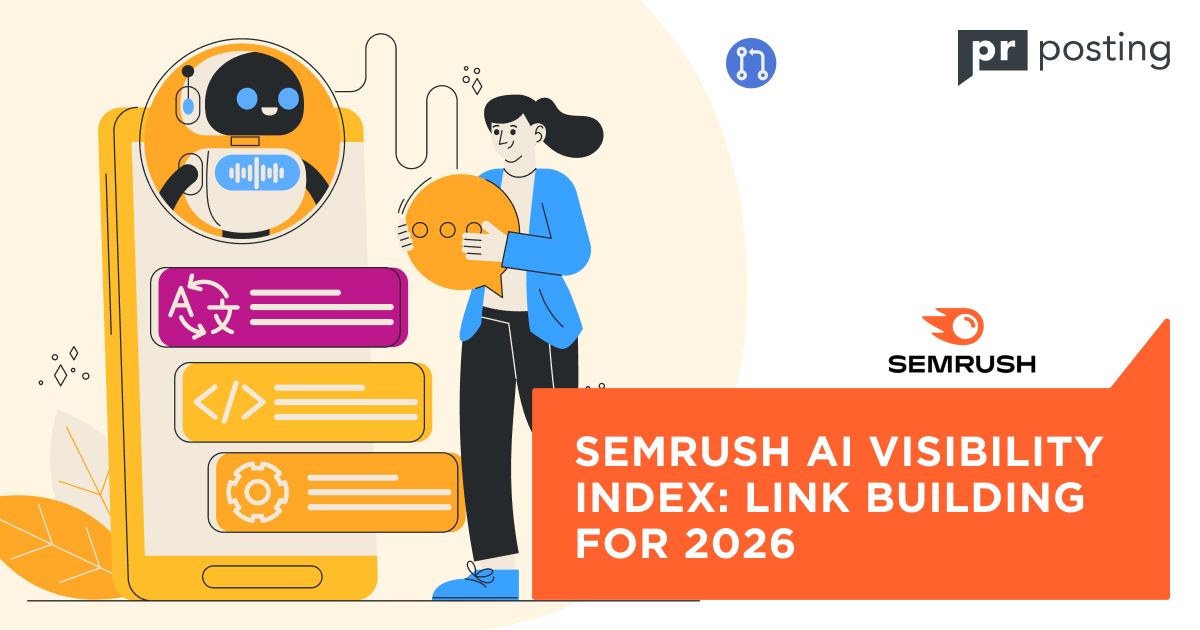
It replaces traditional keyword rankings by tracking how frequently AI models like ChatGPT and Gemini cite your brand.
By optimizing for Semrush AI Visibility Index, you shift from chasing simple traffic to securing AI agent recommendations.
Key Takeaways
- The Semrush AI Visibility Index tracks brand Share of Voice within AI responses.
- Nowadays, the priority is on actual verification rather than simply increasing the number of backlinks.
- Success requires semantic relevance and consistent entity trust signals.
What is the AI Visibility Index?
The AI visibility index is a performance benchmark measuring how often a brand is mentioned or cited favorably across generative AI platforms.
Pioneered by Semrush, it tracks Share of Voice within AI-generated responses.
Instead of focusing on SERP rank, this metric highlights a brand’s authority within the LLM-driven answers.
Basically, it tells you if the AI sees you. And more importantly, if it trusts you.
Defining the New Benchmark of Authority
Semrush’s AI-powered visibility index establishes a baseline for assessing brand value.
As search engines increasingly focus on search engine optimization, this metric helps predict future traffic potential.
It monitors your brand’s footprint in the new digital marketplace. It moves beyond traditional SEO tracking.
It analyzes AI trust patterns and quantifies your Share of Voice.
This is not about being visible to humans. It is about being visible to AI agents.
Why AI Mentions Matter Now
Traditional SEO was based on link building. You fought for the top spot on the page to get people to click through to your site.
But things have changed. Now, people ask a bot a question, and the bot produces a single answer. If your brand isn’t included in that answer, it’s as if you don’t exist for that user.
The AI Visibility Index tracks this specific disappearance. It analyzes how models like GPT or Claude evaluate your data compared to everyone else’s data.
AI reads the whole internet to decide who the experts are. They look for consensus. They look for citations.
If AI views your brand as a top source of information on a particular topic, your visibility score increases.
What the AI Visibility Index Actually Tracks
The system analyzes the emotional tone and context of the mention.
Mentioning your product as “buggy” will harm you, while being called “the industry standard” will boost your authority in the system.
- Frequency of Citations. How many times does the bot extract facts from your domain?
- Sentiment Alignment. Whether the AI recommends you or warns against you.
- Contextual Relevance. How often do you appear for specific, high-value queries?
The math behind this is simple. More trust equals more mentions.
If you want to stay relevant, you have to feed the models what they want.
They want structured data. They want clear, factual statements that are easy to parse.
- Schema Markup. Making your data readable for AI.
- Backlink Quality. Getting mentions from other high-authority sites that the AI already trusts.
- Direct Answers. Write content that answers a question in the first paragraph.
You can’t just guess anymore. You need a way to find out what the AI thinks before traffic drops to zero.
The AI Visibility Index from Semrush is just such an indicator.
It highlights the gaps in your content. It tells you where you are winning and where the bot is choosing your rival instead.
Semrush AI Visibility Index: What is it?
Launched in late 2025, the tool analyzes thousands of real-world prompts to identify which brands AI recommends.
It tracks two critical dimensions to define your score.
AI Mentions
This measures how often your brand name appears in an AI response. It shows simple awareness by the model.
AI Citations
This tracks how often the AI links directly to your website. It proves the AI treats you as a source of truth.
Why Traditional Link Building Is Changing
Traditional link building fails when targeting AI agents because LLMs require verification, not just popularity metrics.
| Feature | Traditional Link Building | AI Visibility Link Building |
| Primary Goal | Increase Domain Authority | Earn Algorithmic Trust |
| Success Metric | Number of Links | Citation Rate |
| Source Type | High-Traffic Sites | Topically Relevant Homes |
| Anchor Text | Keyword-Rich | Contextual & Entity-Reinforcing |
Retrieval-Augmented Generation (RAG) systems use links to validate brand claims.
If AI cannot confirm your brand’s expertise through a network of trusted citations, you will not appear in AI answers.
High Domain Rating is no longer enough for visibility. Links serve a new purpose now. They are not merely for traffic. They are for trust.
Backlinks as Semantic Proof
Backlinks function as external evidence of Topical Alignment for AI models. These agents look for entity overlap.
If high-authority sites in your specific niche link to you within a relevant context, AI identifies you as a trusted source.
- Topical Alignment. Links must match your core business entities.
- Contextual Relevance. The surrounding text matters more than the link itself.
- Entity Overlap. AI agents look for shared connections between trusted domains.
How to Measure ROI with the AI Visibility Index
Measuring Your Brand AI Visibility
AI Visibility Index tools are crucial. They help bridge the gap between your online visibility and conversions.
You need to know your score. You need to know your competitors’ results.
When a user submits a query to artificial intelligence, and it selects your brand, conversions happen quickly.
This process often allows you to bypass traditional search results. You need to measure the quality of these AI-driven interactions.
Key AI Visibility Metrics
Use the AI visibility metrics to track your performance.
The following metrics show how AI agents perceive your brand.
- AI Share of Voice (SOV). Your brand’s percentage of mentions in a specific category.
- The Mention-Source Divide. A metric showing if you are being talked about (mentions) but not verified (citations).
- Sentiment Analysis. Are the AI models recommending you enthusiastically or merely listing you as an alternative?
According to Semrush, brands with higher citation rates see faster conversion times.
Tracking Success with Semrush
Semrush AI Visibility Index is a performance indicator that measures how frequently and positively a brand is mentioned on generative AI platforms.
The launch of the AI Visibility Index from Semrush has changed our approach to authority tracking.
To calculate ROI:
- Track your AI Visibility Index over time.
- Compare the growing index figures with the volume of potential clients attracted by AI agents.
- Calculate your lead acquisition cost using AI.
How to Optimize Content for AI Visibility
To maximize your website’s visibility to AI, you need to align your website content with LLM trust signals.
This involves mapping your entity data using structured code and creating unique content that AI will be compelled to link to.
Unlike traditional SEO, this process relies on algorithmic selection rather than human clicks.
You need to provide AI with verifiable, clean data.
Identify Citation Gaps
Use Semrush to find sources that link to your competitors but not to you. These gaps point to great link-building opportunities.
- Run a competitor analysis.
- Map their citation profile.
- Target those specific domains.
- Focus on sites that LLMs already trust.
Optimize for Entities
Your AI visibility index, SEMrush score, relies on structural clarity.
Ensure your website’s “About” and “Product” pages use precise structured data.
- Implement JSON-LD to help AI crawlers parse your facts efficiently.
- Use the Organisation schema for your brand.
- Implement the Product schema for offerings.
- Keep definitions concise and accurate.
If AI can’t process your data, it won’t trust you. Large language models don’t read your blog posts for fun.
They’re looking for facts to remain useful. If you want a high score, you must create exactly what it takes to make AI feel confident about your brand.
This means you need to stop writing for Google and start writing for AI agents.
The point is to become that authoritative source that the bot cannot ignore.
Searching for the Missing Links
By analyzing the gaps in your cited sources, you are looking for online visibility that you simply don’t have yet.
If a major tech site talks about your rival but ignores you, AI assumes your rival is the leader.
It is a popularity contest where the judges are algorithms. You need to find the specific places where your competitors are mentioned and get your name there, too.
- Industry Directories. Get listed in every niche database.
- Review Aggregators. Make sure your positive reviews are visible on sites analyzed by AI.
- White Papers. Publish data that other sites want to link to.
This is simple math for the machine. More mentions on high-quality sites equal more trust.
Use Structured Data
You have to realize that bots love order. If your site is a mess of fancy fonts and hidden text, AI gets confused.
Use JSON-LD to tell AI exactly who you are without any guesswork.
This is like giving a cheat sheet for your business. You want to define your brand as a specific entity, so the bot does not mix you up with someone else.
- SameAs Tags. Link your social profiles in your schema.
- Founder Data. Tell the bot exactly who started the company.
- Service Areas. Be clear about where you actually do business.
Essentially, if the bot has to guess, you lose. It is necessary to provide properly structured data.
Give AI a reason to pick you. If your data is clean, AI will reward you with a higher visibility score.
Build “Citation Magnets”
AI agents adore original research.
Create data studies that offer unique value. These “citation magnets” are frequently cited because the information they present is not found elsewhere.
- Gather proprietary industry data.
- Publish a comprehensive study.
- Promote it to industry journalists.
Unique data wins every time.
Link Building for AI Visibility
A winning strategy for AI Visibility Index requires diversifying your link sources beyond standard guest posts.
You must secure mentions where AI models “listen” to community sentiment.
This includes industry forums, Reddit, and niche news sites. Links are now evidence, not just navigation.
Strategic Link Building Actions
- Diversify Sources. Don’t just chase guest posts. Seek mentions on Reddit, industry forums, and niche news sites.
- Focus on “Actionable” Links. Prioritize placements in “Best of” listicles and “How-to” guides. AI summaries like these formats.
- Monitor SearchBot Access. Ensure OAI-SearchBot and Bingbot can crawl your pages. Block paywalls and complex JavaScript from these bots.
It’s all about access and relevance.
Common Mistakes in AI Visibility Strategy
To achieve high visibility in generative AI platforms, you must avoid just chasing metrics.
The AI Visibility Index from Semrush rewards trust signals over raw link volume.
Success requires focusing on semantic relevance and community sentiment rather than outdated SEO tactics.
Stop counting links. Start counting citations.
Chasing Raw Volume
Chasing raw link volume is a losing strategy in 2026.
A bunch of low-quality links will not move your AI visibility index score. Conversely, five links from topically relevant authorities will boost your trust.
LLMs ignore spammy link profiles. Instead, they look for high-quality endorsements.
- Quality over Quantity. Focus on authority, not link count.
- Topical Relevance. Links must match your core entities.
- Algorithmic Trust. Top sites provide massive trust signals.
Ignoring Unlinked Mentions
Ignoring unlinked mentions is a big mistake. AI models read the whole web, not just links.
Being mentioned on a major news site without a link is now a massive trust signal for the AI Visibility Index.
LLMs connect entities across diverse platforms. They do not require a clickable path to measure your relevance.
- Monitor Brand Mentions. Track your brand name across the web.
- Evaluate Sentiment. Positive mentions build authority.
- Entity Association. Connect your brand with trusted entities.
Neglecting Structured Data
Neglecting structured data limits your visibility dramatically. If your content is not scannable for an AI, it won’t be cited.
This remains true regardless of how many links you have acquired.
LLMs need clean JSON-LD data to parse facts. They must understand your brand identity precisely.
- JSON-LD Implementation. Use Schema markup on all product pages.
- Fact Extraction. Structured data makes facts easily readable.
- Semantic Clutter. Remove vague content that confuses agents.
Conclusions
Mastering AI visibility requires a shift from traditional tactics to entity-based modeling.
The AI visibility index is the new “PageRank.” It measures trust, not just traffic.
Link building must focus on semantic relevance and community sentiment.
Semrush’s AI tools are essential for tracking your brand’s presence in AI responses.



More Like This
ChatGPT Links and Link Building for Entity Trust