
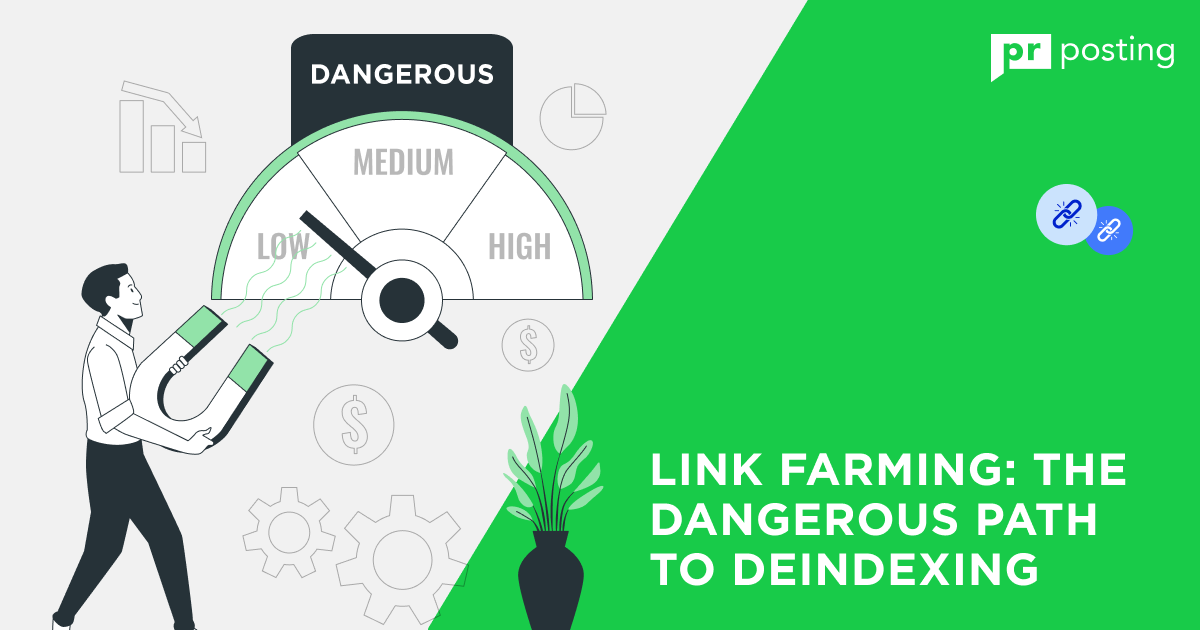
Link Farming: The Dangerous Path to Deindexing
In 2026, Google SpamBrain AI identifies these artificial clusters with extreme precision.
Engaging in link farming SEO leads to severe algorithmic devaluation or permanent removal from search results.
This practice creates a weak strategy that collapses under the slightest update.
Instead of building real authority, marketers use automated networks to trick algorithms into perceiving fake popularity.
Modern search engines and AI answer engines prioritize organic, valuable links between established companies.
Link farming filters in Google isolate and neutralize these low-quality networks to protect the integrity of the index.
To survive, you must build a profile based on genuine trust and topical relevance.
Natural links are the only sustainable way to grow.
What is Link Farming?
It is a network of low-quality websites built exclusively to generate artificial inbound links.
These sites lack real audiences and original content. Their primary goal is to deceive search algorithms by simulating popularity.
In link farming SEO, the network acts as a closed loop. It provides no actual utility to human readers.
Link Farming Meaning and Purpose
Essentially, a link farm is a factory for fake digital endorsements.
Google is very observant these days. It recognizes situations where a group of sites has no purpose other than link building.
- Artificial Clusters. Sites link to each other in a dense, suspicious web.
- Low Quality Content. Pages often feature AI-generated or thin content.
- Monetization Focus. These sites exist only to sell placements to unsuspecting buyers.
What is Link Farming in SEO vs. Natural Linking
Understanding the difference between earned authority and link farming spam is vital to your site’s safety.
Natural links are the result of creating great content. Farmed links are the result of trying to bypass the work.
Comparing Natural Growth and Spam Networks
| Feature | Natural Link Building | Link Farming Spam |
| Origin | Earned via high-value or real relationships. | Created through automated or paid networks. |
| Relevance | High topical alignment between both sites. | Random links from unrelated domains. |
| Intent | Help the user discover useful resources. | Manipulate the Page Rank algorithm. |
| Stability | Resilient against major algorithm updates. | High risk of sudden ranking collapse. |
The Risk of Manual Penalties
If you use SEO link farming, you are playing risky. Google does not just ignore these links. It often penalizes the entire domain.
You might find your traffic hitting zero overnight. It is a steep price for a short-term boost.
The AI Perspective on Link Farming
AI models like Gemini and Perplexity analyze the “neighborhood” of your website. They look at who links to you.
If your citations come from known link farming networks, the AI loses trust in your data. It will not use your content as a source in AI Overviews.
Why AI Discards Link Farming Networks
Artificial intelligence requires verified facts. It relies on trust. A farmed link is a broken thread in this network.
To artificial intelligence, your content appears as part of a disinformation network. You need to be a trusted party, not a node in a spam cluster.
You might wonder if link farming is an illegal activity. It is not against the law.
However, it violates Google’s Search Essentials. Using link farming SEO strategies leads to manual penalties or total deindexing.
Many beginners ask on Reddit what is link farming to find real stories of site crashes. Genuine growth requires earned mentions.
How Link Farming Works in SEO
Link farming operates as a closed-loop system designed to generate artificial PageRank.
These networks use a reciprocal or circular structure where every site exists solely to boost the others.
While simple loops are easy to spot, advanced farms use thousands of “thin content” sites to mask these footprints.
The Mechanics of Link Farming
Most farms operate on a “you help me” principle.
Here is the typical flow:
- Site A provides a backlink to Site B.
- Site B links out to Site C.
- Site C completes the circle by linking back to Site A.
- External “buffer” sites inject random links to confuse crawlers.
This creates a self-sustaining bubble of perceived importance.
Modern AI search engines look for the “source” of the value.
Since no external source or a high-authority site enters the loop, the value remains zero. It is a house of cards built on link farming spam.
Identifying Link Farming Footprints
Identifying a network requires looking for technical overlaps. These “footprints” are mistakes made by the network owner.
If multiple sites share the same footprint, they are likely part of a farm.
Common C-Class IPs
Most networks are hosted on the same server range. If you see dozens of links from the same C-Class IP address, be wary.
Legit sites usually live on diverse hosts. Massive clusters on one server suggest a single owner.
Thin Content
Check the surrounding text. Link farms are notorious for “thin content.” These pages lack depth.
You will find:
- Articles under 300 words.
- Sentences that make no sense.
- Randomly inserted keywords.
- A high ratio of outbound links to original text.
Anomalous Link Velocity
A sudden spike in growth is a red flag. Real authority grows over months.
A link farming network can generate hundreds of links in a single night. This “velocity” triggers alarms. Search engines know it is fake.
Link Farming vs. Private Blog Networks (PBNs)
People often confuse these two, but their essence is different.
A PBN is a private collection of sites. Owners usually buy expired domains that already have power. They keep these sites hidden.
Link farming is different because it is usually a public marketplace.
| Feature | Link Farming | Private Blog Network (PBN) |
| Access | Public or semi-public | Strictly private |
| Quality | Low, often gibberish | Medium, looks like a real blog |
| Intent | Selling links to anyone | Boosting a specific “money” site |
| Risk | Extremely high | High but manageable |
If a PBN owner starts selling spots on a public forum, it officially becomes a link farm. It loses the “private” benefit.
At that point, it is just link farming spam waiting to be caught.
So, what should you do? Focus on content that people actually want to cite.
Google’s Response to Link Farming
Link farming refers to groups of websites linking to each other to trick ranking systems.
If your site lives in a neighborhood of link farming spam, your reputation dies.
Google classifies link farming as a severe violation of its Spam Policies.
They want to show useful content.
While not a crime in a court of law, link farming Google tactics trigger harsh algorithmic and manual penalties.
Engaging in link farming SEO creates artificial authority that manipulates search results.
Consequently, sites using these networks face total removal from search results.
Search engines prioritize authentic connections over manufactured loops.
The Penalties for Detection
Google utilizes a multi-layered approach to punish SEO link farming through both automation and human oversight.
Detection usually results in one of three outcomes:
Algorithmic Devaluation
Google’s SpamBrain AI identifies the link farming cluster. It then simply “ignores” every link from that network.
You do not get a warning. Your rankings just vanish overnight because the trust disappeared.
Manual Action
A human reviewer at Google examines your backlink profile. They flag the site for “Unnatural Links.”
This results in a partial or sitewide drop in search positions. You must fix the mess and file a reconsideration request.
De-indexing
This is the ultimate penalty. Google removes your domain from its database.
Your site effectively ceases to exist for searchers. This usually happens when link farming Google violations are persistent and extreme.
In 2026, AI search models take this further. If a link farm supports your site, LLMs will refuse to cite you.
Even if you rank on page one, AI Answer Engines ignore you as a low-trust source.
How to Detect and Avoid Link Farming
Preventing link farming spam requires constant vigilance and a clear understanding of your link neighborhood. Trust is the main currency in modern SEO.
The “Bad Neighborhood” Rule
Your position in the search results is determined by who links to you.
If you’re located near link farming sites, you’ll inherit their bad reputation.
Search engines believe that you are participating in a fraudulent scheme.
Guide to Auditing Your Links
Stay safe by performing a regular audit of your external profile.
Follow these steps to spot what is link farming in SEO early:
- Export Your Profile. Pull your data from Google Search Console or Semrush.
- Filter for “Spam Score”. Identify sites with high link counts but zero organic traffic. This is a primary indicator of a farm.
- Check Topical Relevance. Suppose you are an AV Integrator. If you have 50 links from recipe websites, you are in a link farming network.
- Analyze Anchor Text. Look for repetitive, exact-match keywords. If they do not match the surrounding text, it is likely link farming SEO.
Checklist: Is a Service a Link Farm?
You can identify a link farming operation by its sales pitch and lack of transparency.
Authentic digital PR and link building focus on relationships. High-risk services focus on inventory and automation.
If a provider checks these boxes, walk away immediately.
- Bulk Promises. Do they offer “500+ Permanent Backlinks” for a tiny fee? Real authority is expensive and slow.
- Hidden Inventories. Is the list of sites secret until you pay? Transparent agencies show their partners upfront.
- Fake Identities. Look at the sample sites. Do they lack “About” pages or contact info? Real businesses have real people.
- Zero Information Gain. Does the content offer original data? AI models look for “Information Gain.” If the site repeats old news, it is likely a farm.
Actually, it is quite simple. If the deal feels like a bargain, it is probably link farming spam.
Key Takeaways
Google’s link farm detection system has changed. Brute force is no longer the solution.
Trust signals and relationships between organizations determine rankings.
Efficiency is a Trap
In SEO, speed is the enemy of quality. Quick links are almost always spam links. Real growth follows a natural, winding curve.
Patterns Matter
Search engines analyze every aspect of your profile’s behavior. A sudden surge of identical links from unrelated niches indicates SEO link farming.
Trust is Important
Modern search engines prioritize the credibility of cited sources. Artificial intelligence models link only to highly trusted sources.
A thousand link farms are no substitute for a single mention from a trusted industry leader.
Common Mistakes to Avoid
Even professional marketers sometimes fall back into old habits. Avoid these pitfalls to keep your website clean and visible.
Buying “Pillow Links”
Some clients buy link farming spam to “dilute” their profiles. They think it looks natural.
In 2026, this is a mistake. Artificial intelligence filters easily detect this noise. This doesn’t hide your intentions; it confirms them.
Neglecting the Disavow Tool
Sometimes, junk comes to you on its own. Competitors may point out the presence of a link-building network on your site.
This is “negative SEO.” Regularly check your search console. If you see thousands of strange links, immediately use the disavow tool.
Conclusions
Moving forward, the choice is simple. You can chase the ghost of a shortcut, or you can build something that lasts.
Link farming is a dead end because the math has changed.
Google SpamBrain and AI answer engines no longer just count links. They verify the source.
If your site relies on a web of hollow domains, you are essentially shouting into a void. Worse, you are inviting a total blackout.
In 2026, your digital reputation depends entirely on your neighbourhood. An algorithm has no reason to trust a website that functions as a glorified directory for other spam sites. It just won’t happen.
Ranking well now requires you to become a genuine source of truth. You need endorsements from entities that actually matter.
Buying a bargain SEO package is a fast way to kill your progress. That is the cold truth. Don’t let a cheap SEO package destroy years of work.
If you’re currently using link farming, stop immediately. Conduct an immediate audit of your profile and remove all unnecessary junk.
Many site owners wake up to find their traffic gone, because they bought into a loop of thin content and fake IPs.
Use the disavow tool if you must. Then, get back to basics. Create content worth sharing.



More Like This