
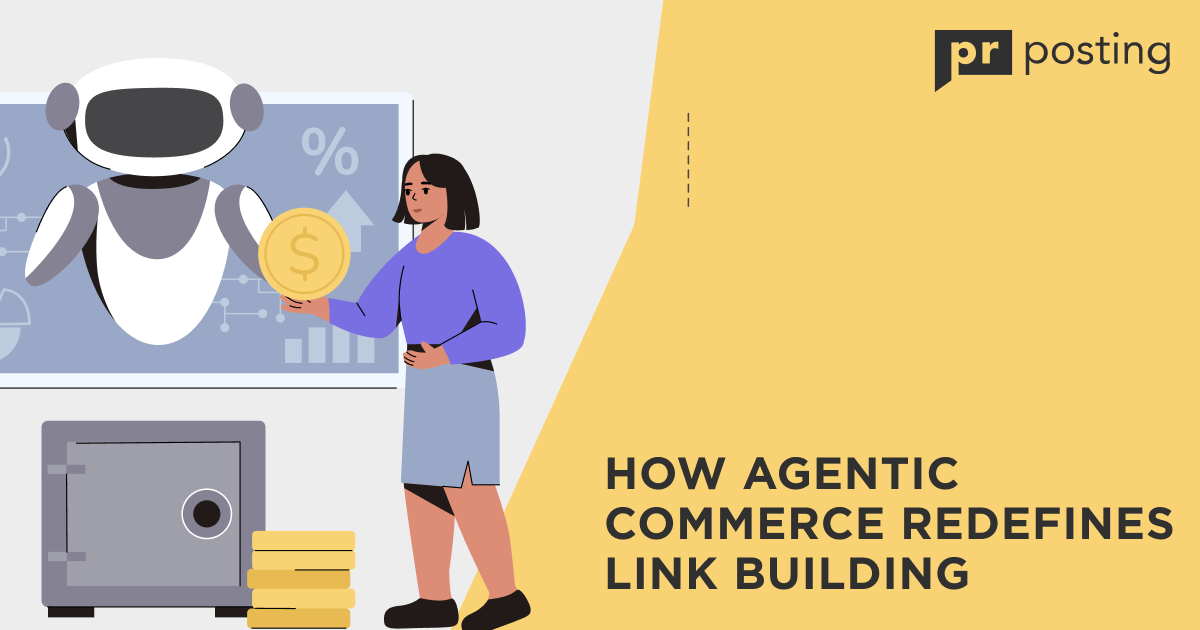
How Agentic Commerce Redefines Link Building
For SEO specialists, this means a shift from “optimizing for links” to “optimizing for personalized recommendations.”
Digital trust is no longer earned through catchy headlines, but through verifiable signals and API-based authority.
Key Takeaways
- Structured Data. Audit your site for Universal Commerce Protocol (UCP) and Model Context Protocol (MCP)compliance.
- Authority. Secure mentions in curated “Best-of” lists to trigger agentic trust algorithms.
- Real-Time Feeds. Sync pricing and inventory via APIs to ensure agents see actionable data.
- Sentiment Management. Monitor web mentions to ensure agents categorize your brand as “Safe for Purchase.”
What is Agentic AI Commerce?
Agentic commerce is the use of autonomous AI agents to manage the entire shopping journey from discovery to checkout.
These systems interpret complex user intent, such as “Find a durable, eco-friendly laptop bag for under $150.”
They reason through options, compare technical specs, and finish the purchase without manual human clicks.
Actually, an AI agent acts with delegated authority. It doesn’t just suggest. It executes.
To thrive here, your brand must be more than visible. It must be executable by AI shoppers.
Agentic AI Commerce vs. Traditional E-commerce
Traditional e-commerce relies on a human navigator. Users browse tabs, compare prices, and manually enter credit card info.
In agentic commerce, the AI agent is the navigator. It uses APIs and structured feeds to make decisions in milliseconds.
How Can Trust Be Built in Agentic Commerce?
AI agents do not care about your beautiful web design. They prioritize data accuracy, cryptographic verification, and entity salience.
They look for a clear trail of accountability between the merchant and the payment service.
To receive recommendations from an AI agent, your brand needs reliable and structured data.
If your inventory levels or prices are outdated, the agent will move to a competitor. Trust is now a technical requirement.
- Standardized Protocols. Implement UCP so agents can read your checkout flow.
- Cryptographic Proof. Use secure digital signatures to verify your brand’s identity.
- Data Accuracy. Ensure your PIM (Product Information Management) system feeds the AI directly.
How to Implement Agentic Commerce Workflows
We have to stop building websites that just sit there like digital paper.
Your website must provide machine-readable hooks that allow AI agents to request information about product availability or delivery times in real-time.
- Adopt UCP. Join the Universal Commerce Protocol waitlist to enable direct AI buying.
- Create lightweight API endpoints for agents to check SKU availability. Refine Entity Signals.
- Expose APIs. Create lightweight API endpoints for agents to check SKU availability.
- Refine Entity Signals. Use branded web mentions on authority sites to build “Agentic Trust.”
Utilise branded web mentions on authoritative sites to establish agentic trust.
By 2026, being the top result isn’t enough. You must be the chosen action.
The Importance of an AI-Friendly Website
For years, businesses optimized for humans scrolling through pretty layouts. Now, the buyer is often an AI agent.
If your data remains locked inside a visual layer, you become invisible to the new economy. You need to change your methodology.
The Power of Machine Hooks
Machine Context Protocol (MCP) bindings allow AI to skip the “reading” phase and go straight to the “doing” phase.
Instead of an LLM trying to guess if you have a blue sweater in stock by scraping your site, the agent queries a direct hook.
It makes your inventory part of the AI agent’s logic.
How to Build a Website Noticeable to AI Agents
- Standardize your data schemas. Use JSON formats that AI models recognize instantly without needing extra prompts.
- Prioritize latency. An agent will move on if your API takes five seconds to respond. Speed is now a sales metric.
- Secure the handshake. Lock the connection. Use API keys so agents can be sure they are talking to the official source.
The Role of the Universal Commerce Protocol in Agentic Commerce
UCP, or the Universal Commerce Protocol, acts as a bridge. It creates a shared language for transactions.
When you join this waitlist, you are preparing for a future where a user tells their assistant to “buy the best organic coffee,” and the assistant executes the trade without a single click from the human.
This requires more than just a checkout page. It requires a protocol.
Trust also matters here. You cannot just exist. You have to be verified.
Agentic trust is the reputation you earn through consistent data. If AI recommends your product and the link is broken, AI learns to ignore you.
How to Build AI-Agentic Trust
Maintaining a positive unlinked brand mention profile is now critical. Agents use these brand mentions to assess human sentiment and reliability.
If your brand is linked to trusted entities, the agent’s reasoning model assigns you a higher priority.
- Audit Mentions. Track how your brand appears on platforms like Reddit or Quora.
- Cryptographic Proof. Use secure protocols to verify your merchant identity.
- Sentiment Health. Ensure unlinked mentions characterize your brand as “Expert” or “Trusted.”
- Standardized Protocols. Implement UCP so agents can “read” your checkout flow.
- Cryptographic Proof. Use secure digital signatures to verify your brand’s identity.
- Data Accuracy. Ensure your PIM (Product Information Management) system feeds the AI directly.
- Get cited on high-authority websites. AI models look for consensus across the web to verify your identity.
- Keep your SKU data fresh. Relevant information is the fastest way to secure trust.
- Monitor your entity signals. Watch how LLMs categorize your brand in their latent space.
Your goal is to be the default choice for the algorithm. If you are not AI-readable, you are not in agentic commerce.
Summary
- Standardize. Adopt the 2026 Universal Commerce Protocol (UCP) for machine-led communication.
- Connect. Use the Model Context Protocol (MCP) to link your inventory directly to LLM agents.
- Refine. Structure data into “Atomic” blocks to simplify AI summarization and reasoning.
- Verify. Focus on building trust in agentic commerce through entity-based signals.
Step-by-Step Guide: Preparing Your Brand for AI Agents
AI agents seek precision. They demand data that is current, structured, and easy to ingest.
If your site structure is messy, the agent will move to a competitor with a cleaner feed.
- Deploy a Universal Commerce Protocol (UCP). This is the 2026 standard for agentic communication. It makes your catalog machine-readable and actionable for instant checkout.
- Integrate Model Context Protocol (MCP). Connect your secure product database directly to LLM agents. This ensures real-time inventory and pricing accuracy during the reasoning phase.
- Optimize for AEO. Ensure your product descriptions are “Atomic.” These are small, factual blocks of text. AI can summarize them without losing critical details or context.
Link Building in Agentic Commerce
In 2026, Link Building is no longer about volume. It is about Verification.
If an agent is spending a human’s money, it requires proof of trust.
Before making a deal, companies seek digital verification of their credibility. This is a new frontier in SEO.
Essentially, having a link is now considered a security clearance.
AI Agents look for signals on source sites like Consumer Reports to confirm your organization’s authenticity.
They want to know you are a legitimate player in your category.
Entity Backlinks
An entity backlink is like a digital passport stamp. Traditional SEO used to focus on any link that passed authority.
Now, if a major industry publication links to you, AI assumes you belong in that specific neighborhood of the internet.
- Verified Associations. Links from academic or government sites act as hard proof of your existence.
- Contextual Weight. A link from a niche leader tells the agent exactly what problems you solve.
- Structural Integrity. These links help the bot map out how you fit into the wider market.
High-authority links act as a trust credential for autonomous shoppers.
Co-Citation
Co-citation is a bit like social dynamics. If your brand is mentioned in the same paragraph as Nike or Apple, AI assumes you share some of their trust.
You don’t even need a direct link for this to work. The proximity of your name to industry giants tells the machine that you are a peer.
Consistent mentions alongside industry leaders boost your brand’s Salience Score.
Basically, the bot decides you are a main character in your industry.
Sentiment Analysis
AI Agents use Natural Language Processing to figure out if people actually like you. They look for specific markers in the wild.
AI Agents read millions of branded web mentions in seconds. A positive profile is now as vital as a Dofollow link.
- Customer Reviews. Low star counts are a direct signal to the agent to avoid recommending you.
- Social Proof. Casual mentions on forums like Reddit provide raw, unfiltered data on your reliability.
- Media Tone. Press releases are ignored, but organic news stories are weighed heavily.
If the internet hates your service, the AI agent will hide you. It protects its user from a bad experience. A positive reputation is now a functional requirement for visibility. It is that simple.
The New Trust Architecture
Think of an AI agent as a private investigator with infinite patience.
It doesn’t just look at your website. It cross-references your existence against a massive web of third-party data.
When these bots scan source sites, they are trying to build a digital identity for you.
If Consumer Reports or a government database mentions your brand, AI marks you as a verified entity.
This process moves beyond simple SEO because the goal isn’t just a high ranking. It is a high probability of being the right answer for a user.
What Are the Best Tools for Agentic Commerce?
Selecting the best tools for agentic commerce requires a focus on interoperability and real-time data exchange.
These platforms allow AI agents to find, evaluate, and purchase your products without human intervention.
They bridge the gap between your inventory and the reasoning models used by LLMs.
Actually, your choice must prioritize API-first architectures. AI agents prefer data they can ingest instantly.
If your tools don’t support autonomous workflows, you will miss out on the silent shopper revolution.
- The Stripe Agentic Commerce Suite. This tool facilitates autonomous payments. It uses cryptographically signed mandates to authorize agent spending.
- LangGraph. A powerful framework for building multi-agent workflows. It handles the logic for complex commerce negotiations between buyer and seller agents.
- Mirakl Nexus. This platform connects merchant catalogs to third-party agentic networks. It ensures your products are available for autonomous discovery.
- Ahrefs Brand Radar. A specialized tracker. Use it to monitor your brand’s “Citation Share” in AI Overviews and agent responses.
Common Mistakes in Agentic Commerce
Many brands fail by optimizing only for humans. If your data sits behind JS-heavy popups, AI agents will simply skip your site.
They cannot “click” out of a marketing overlay. They need clean, raw data access. Another error is relying on static pricing.
In agentic commerce, AI agents prefer merchants whose pricing adapts to real-time market data. Fixed costs often look like outdated data to a machine.
This can lead to your brand being filtered out of the final selection.
Blocking Crawlers
Do not hide product facts behind interactive elements.
Lack of API Depth
Ensure your stock levels are accessible via machine-readable endpoints. Poor Entity Clarity
If an agent cannot verify your business identity, it will not risk a purchase.
Designing for the Invisible Shopper
Optimizing for a customer who can read, scan, and click is vastly different from optimizing for an AI agent that just needs raw data.
You might have the most beautiful, functional website on the internet, but if it is covered in pop-ups, you are losing.
That newsletter signup form that covers the product description? The bot cannot click the X to close it.
To that bot, your product description does not exist. It just sees a wall of code meant to block interaction. You have to feed the AI agents directly.
Static Pricing
Imagine a bot looking for a specific type of coffee maker. It checks five stores instantly.
Four of them update their prices every hour based on competitor data and demand. Your store keeps the same price listed for months.
The bot assumes your information is stale, dead, or just wrong. Why would it risk a purchase for its user if it cannot guarantee the price is current?
It will skip you without a second thought. You need systems that allow for real-time data exchange.
- Real Time Data. Your system must push price updates to the agent immediately.
- Dynamic Inventory. If an item sells out in the store, the agent must know before they try to add it to a cart.
- Contextual Offers. Agents appreciate price adjustments based on the user’s specific shipping location.
Agentic Commerce Friendly Website Features
You can also think about it this way: the bot is responsible for a human’s money.
It will not take risks. It needs absolute certainty.
- Structure Your Data. Use schema markup to define product names, prices, and descriptions clearly.
- API Accessibility. Make your data endpoints fast and free of unnecessary authentication hurdles.
- Trust Signals. Ensure your entity is listed in public databases and matches your website information exactly.
If an AI agent cannot verify your company is real, it will not make a purchase.
It will just find a brand that seems safer. Your goal is to make it impossible for the bot to ignore your data.
Conclusions
Agentic commerce is rewriting the rules of digital trade. To capture the AI agentic shopper, you must move beyond the read-only website.
Success in agentic commerce requires a blend of machine-verifiable trust and technical readiness.
Indeed, the future of SEO lies in being trustworthy and visible online.
Your brand must be more than just a search result. It must be a trusted partner for AI agents.
Start today with an audit of your entity signals. The opportunity to implement new technologies is rapidly declining.



More Like This
Why Brand Mentions Are the New Backlinks