
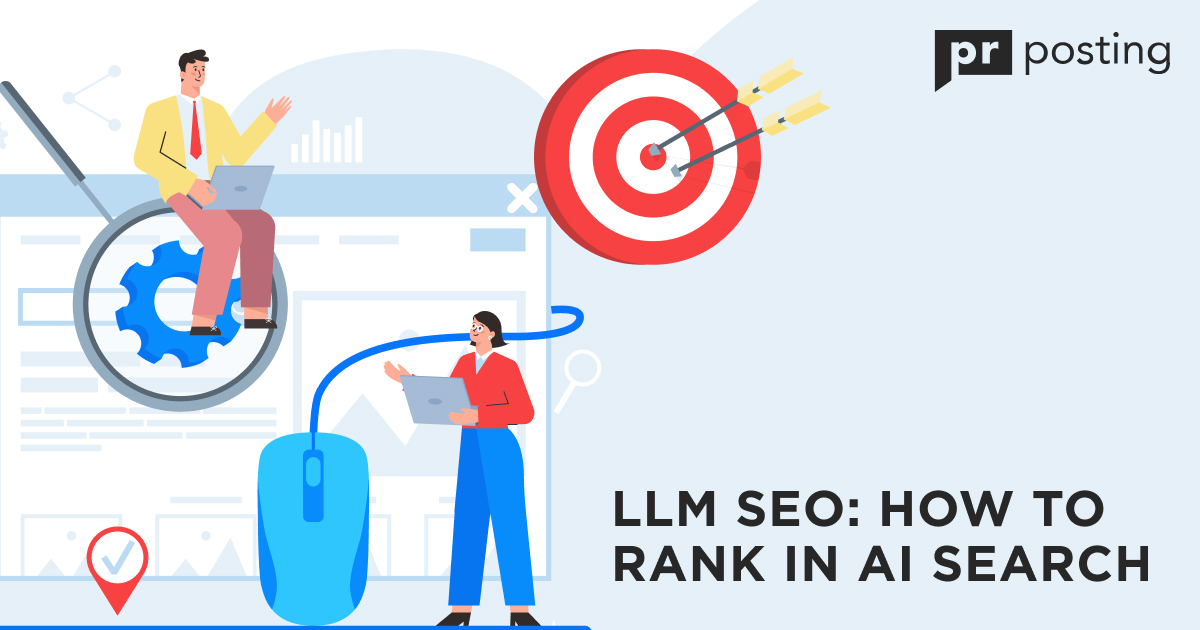
LLM SEO: How to Rank in AI Search
To succeed in this new environment, brands must focus on entity authority and citation share rather than just traditional keyword rankings.
LLM SEO is the art of becoming the primary data source for AI response engines. AI systems use Retrieval Augmented Generation (RAG) to pull the most credible information from across the web.
If your brand provides high-density, factually grounded data, it becomes the cited expert in AI Overviews. This shift requires moving from “writing for clicks” to “writing for insights.”
Essentially, you want AI to trust your site enough to repeat your claims to users.
Effective LLM SEO ensures your business remains visible in a world where conversational answers replace traditional search results.
Key Takeaways on LLM SEO for 2026
- Be the Source. AI models prioritize original data. Conduct your own surveys and publish the results to become a cited authority.
- Think in Entities. Optimize for “What you are,” not just “What you sell.” Define your niche clearly so LLM SEO trackers can categorize you correctly.
- Monitor Your Citations. Use the best LLM SEO tracking software to keep your brand top of mind.
What is LLM in SEO?
LLM SEO refers to the discovery layer where AI models act as the gatekeepers of information. It represents a move away from the traditional “ten blue links.”
Instead, it focuses on how Generative AI retrieves and summarizes your brand’s data.
Defining the AI Discovery Layer
LLM SEO creates a path for your brand to become the “preferred source” for generative engines.
When users ask conversational questions, these models scan the web for the most reliable facts. They use a process called Retrieval Augmented Generation.
This technology connects the model’s reasoning to real-world data. To win here, you must prove your site is the definitive authority on a topic.
It is about being the most trustworthy node in the digital knowledge graph.
How Does LLM SEO Work?
To understand how does LLM SEO work, you must realize that AI engines do not just crawl text; they strive to comprehend relationships.
They look for specific markers that signal high information density and structural clarity.
- Direct Answers. You must provide content that resolves user intent instantly. AI models favor “answer first” structures.
- Structured Data. Use detailed Schema markup. This helps the machine define your brand as a unique, verified entity. It clarifies who you are and what you offer.
- Citations. High-quality links from external, authoritative sites validate your claims.
Actually, the AI is looking for a reason to trust you. If your data is messy, LLM will simply move on to your competitor.
LLM vs SEO: Which Matters More for Brands Now?
They are two sides of the same coin. Traditional SEO generates the immediate traffic that fuels your daily revenue.
LLM SEO builds the brand equity required to survive the shift toward AI Overviews and Answer Engines.
In 2026, you cannot choose just one. Traditional search visibility provides the signals that AI models use to judge your authority.
Conversely, appearing in AI citations builds a level of trust that traditional rankings cannot match. If an AI recommends your product, the user’s intent is already halfway to a purchase.
One method brings visitors, while the other secures the recommendation.
How to Improve LLM SEO
If you want to know how do I improve LLM SEO, start by auditing your current presence using the best LLM SEO analysis tool.
This helps you see how models like Claude or Perplexity currently perceive your brand authority.
By refining your headers and earning authoritative citations, you move from being a simple webpage to a verified node in the global knowledge graph.
To improve LLM SEO, you must swap old-school keywords for clusters of connected ideas.
Remove redundant adjectives. Focus on nouns and entities.
LLMs care about how concepts link together rather than how many times you repeat a phrase.
You do this by mapping out your main topics and making sure your site code does not block AI crawlers.
Integrating LLM Insights into SEO Strategy
To succeed in AI search, your content must be modular and contain a lot of useful information.
LLMs do not read like humans do. They look for patterns and data clusters. If your strategy feels scattered, the AI will ignore you.
Semantic Density
Semantic density is the measure of how many related concepts you pack into a section.
It is not about keyword stuffing. It is about proving you know your topic.
- Identify the core entity first.
- List five secondary entities.
- Connect them naturally in your text.
- Avoid fluff that dilutes the signal.
This depth helps an LLM SEO tracker see your site as a topical leader.
Implement an /llms.txt File
The /llms.txt file is a new, essential roadmap for AI crawlers. It sits in your root directory like a robots.txt file. It tells models exactly which data is most important.
- Create a markdown file named llms.txt.
- Link to your most critical documentation.
- Provide short, descriptive summaries for each link.
- Place it in your public folder.
This file acts as a direct feed to the LLM. It reduces the “noise” the crawler has to filter through.
Using an LLM SEO analysis tool can help you decide which pages deserve a spot in this file.
Guide to LLM SEO
AI optimization requires a shift in how you structure information.
You are no longer just writing for a person on a phone. You are writing for an answer engine.
Identify Intent: Use an LLM SEO Analysis Tool
You need to see how AI currently describes your niche. Models have biases based on their training data.
An LLM SEO analysis tool reveals these gaps.
- Ask a model to summarize your industry.
- Note which competitors it mentions.
- Look for missing information.
- Fill those gaps with your original research.
Understanding how to integrate LLM insights into SEO strategy starts here. You identify gaps in AI knowledge and fill them. This turns your website into a primary source of updates.
Optimize for Fragments: Use Clear H3 and H4 Headers
AI systems often “clip” answers from larger articles. They look for distinct blocks of text.
Use clear H3 and H4 headers so AI can easily extract your data.
- Keep headers descriptive and literal.
- Follow each header with a 50-word answer.
- Don’t use vague titles like “Next Steps.”
- Try titles like “Best LLM SEO tracking software for Agencies.”
This makes your content suitable for the LLM. It can grab a paragraph and cite you as the expert.
Build Authoritative Citations: Earn Mentions
Citations are the currency of the AI world. You need mentions on Wikipedia, Wikidata, and niche industry lists.
- Update your Wikidata entry regularly.
- Contribute to open-source projects.
- Get listed on “Best of” lists in your sector.
- Collaborate with established industry voices.
If an LLM SEO checker sees your name across multiple trusted sites, your rank climbs. It is about being part of the conversation.
What are the Best LLM SEO Tools
Selecting the best LLM SEO tracking tool is about finding a platform that treats search as a conversation, not just a list of results.
Here are five of the best platforms for LLM SEO tracking:
1. Profound (Best for Enterprise)
Profound is the great choice for large-scale brands. It monitors over 100 million AI search prompts monthly across models like ChatGPT, Claude, and Perplexity.
- Unique Edge. It uses synthetic queries and front-end monitoring to capture real user responses, including screenshots.
- Key Metric. Provides an excellent dashboard of your brand’s Share of Voice (SoV) and sentiment across the entire AI landscape.
2. Allmond (Best for SaaS and Agencies)
Allmond has quickly become a top-rated LLM SEO tracker due to its speed and simplicity. It provides multi-model visibility reports in seconds.
- Unique Edge. It features a “Citation Scan” that specifically checks if your brand’s URL is present in the source links that LLMs use to verify their answers.
- Key Metric. Focuses on citation presence and competitor benchmarking across 67+ countries.
3. Semrush AI Visibility Toolkit (Best All-in-One Integration)
For those already using traditional SEO software, Semrush has added a powerful AI-powered monitoring package.
- Unique Edge. It integrates your traditional organic data with AI visibility, allowing you to see how your backlink strategy affects your AI citations.
- Key Metric. Offers quote-level sentiment scoring to see if the AI describes your product as “the leader” or just “an alternative.”
4. Otterly AI (Best for Affordability)
Otterly AI is LLM SEO tracking software for small teams or freelancers. It turns your target keyword lists into conversational LLM prompts automatically.
- Unique Edge. It includes a “GEO Audit” (Generative Engine Optimization) feature that identifies exactly how to tweak your content for better AI indexing.
- Key Metric. Tracks Share of Voice by persona and sales funnel stage.
5. LLMrefs (Best for Keyword-Centric Strategy)
LLMrefs is a favorite for those moving from traditional search to LLM SEO. Instead of tracking static prompts, it polls AI models based on your core keyword lists.
- Unique Edge. It uses a “fan-out” prompt methodology to see all the different ways a user might ask a question about your industry.
- Key Metric. Identifies “Content Gaps” by showing you the specific source URLs your competitors are winning citations from.
| Tool | Primary Use Case | Model Coverage | Key Feature | Starting Price |
| Profound | Enterprise Strategy | 10+ Engines (Claude, Gemini, etc.) | Real-time sentiment & brand perception | $99/mo (Basic) |
| Allmond | SaaS & E-commerce | ChatGPT, Claude, Perplexity | “Citation Share” across 67+ countries | $29/mo |
| Semrush AI Toolkit | Existing SEO Teams | ChatGPT, Perplexity, Gemini | Integrated SEO/AEO visibility scores | $99/mo (Add-on) |
| Otterly AI | Startups & Growth | ChatGPT, Perplexity, Google AIO | Daily prompt-level mention tracking | $29/mo |
| LLMrefs | Keyword Transitions | 11+ Models (incl. Grok, Meta AI) | “Fan-out” prompt automation | $79/mo |
What’s a Good Platform for LLM SEO Tracking?
The best platforms track “Citation Share” across multiple models.
They move beyond simple keyword ranks. They analyze how often ChatGPT, Claude, and Perplexity reference your URLs as authoritative sources.
- Multi-Model Monitoring. A good LLM SEO analysis tool polls several engines at once.
- Citation Context. The software should show if your brand is the hero or the alternative.
- Source Inspection. You need to see exactly which page the AI is reading.
By tracking these, you uncover where your authority is strong. You will also be able to discover where your competitors are stealing your attention.
The LLM SEO Analysis Toolset
Successful brands use a mix of quantitative and qualitative data. You need numbers to prove growth. You need sentiment to prove trust.
Key Metrics for LLM SEO Tracking
- Citation Frequency. How often does the LLM name your brand? This is your new “Rank 1.”
- Sentiment Score. Is the AI describing your product as “the best” or just “an option”? Positive adjectives drive conversions.
- Zero-Click Resolution. Are users getting what they need from your site via the AI summary? This measures your contribution to the user’s journey.
The LLM SEO Readiness Checklist
Search engines like Perplexity and Claude don’t crawl your site, but rather process your data to resolve user queries instantly.
You succeed when your content is so structured that an AI can scan it without losing context.
This involves a mix of technical signals, like a dedicated LLM SEO tracker file and semantic clarity.
If your page does not offer a direct, quotable answer within the first few paragraphs, AI will likely skip your site in favor of a competitor who does.
Use this checklist to audit your site’s current standing:
- Primary Query Resolution. Does the page answer the main question in the first 100 words? AI models favor “answer-first” structures for quick extraction.
- JSON-LD Schema. Is your Organization and Product schema properly implemented? This machine-readable layer helps artificial intelligence distinguish your brand from others.
- The /llms.txt File. Does your site have an /llms.txt file in the root directory? This provides a direct roadmap for AI crawlers to find your most vital data.
- High-Authority Citations. Do you have external mentions from DR 80+ domains? LLMs use “consensus-based trust” to verify your claims.
Implementing these steps will make your site attractive to Large Language Models.
Common LLM SEO Mistakes to Avoid
Even professional marketers face challenges transitioning to LLM SEO.
The rules have changed. Patterns that worked in 2024 will actively harm your AI visibility in 2026.
Keyword Stuffing
LLMs see through unnatural repetition. Forced phrasing lowers your “Trust Score” and triggers quality filters.
AI models prioritize natural language and semantic relevance over word counts. If a sentence sounds like it was written for a bot, the bot will likely ignore it.
Thin Content
AI won’t cite content that lacks “Information Gain.” This is the unique value your page adds beyond the existing search consensus.
If you simply rehash what is already on the web, an LLM SEO checker will flag your content as redundant.
Always include original research, case studies, or expert insights.
Ignoring Brand Reputation
Negative reviews in the training data are sticky.
AI engines may recommend your competitors if your sentiment scores are low across Reddit, Quora, or niche forums.
Monitoring your digital reputation is just as important as on-page optimization.
Concluding Thoughts
LLM SEO is about earning trust through structure and clarity. It is a long-term play for authority.
If you provide the best answers in the most accessible format, AI engines will reward you with citations.



More Like This
Is Your SEO Working? Measuring Link Building ROI