
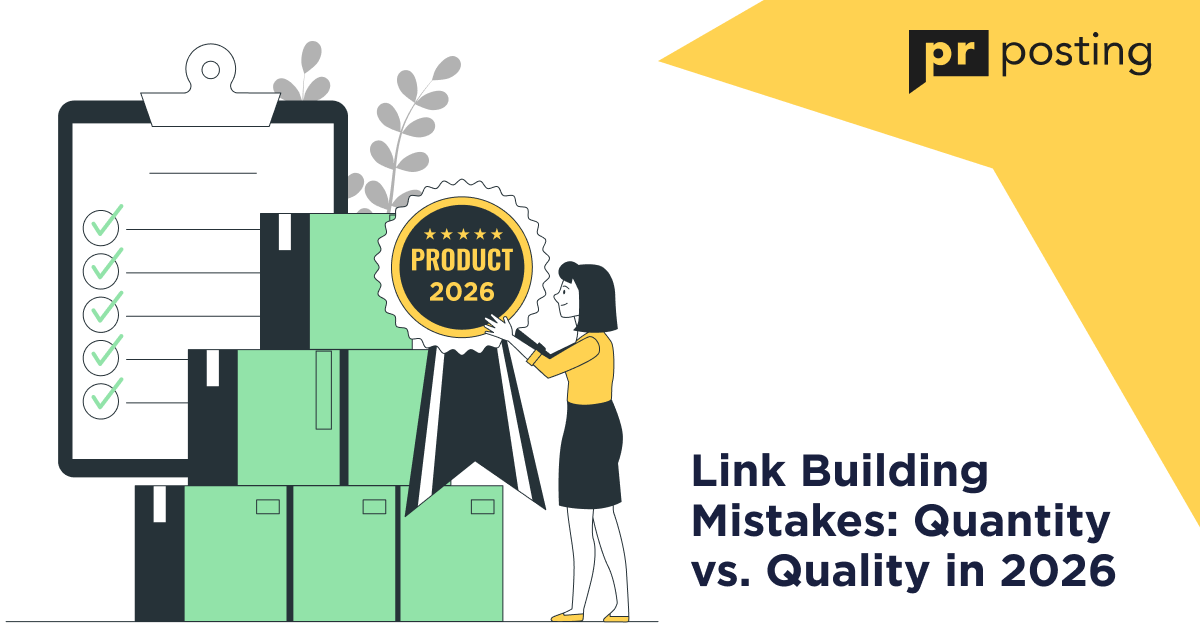
Link Building Mistakes: Quantity vs. Quality in 2026
In 2026, Google uses SpamBrain AI to identify links that lack Information Gain. Your links may appear in the index. However, they don’t give your site any influence on its search rankings.
SEO today requires moving from buying metrics to getting real mentions. Successful strategies prioritize topical relevance over mere numbers.
This article explores how to identify common link building mistakes that drain your budget.
We will focus on the transition from metric manipulation to building real brand authority.
To avoid strategic link building mistakes, you must align your backlink profile with your core entities related to your business.
Metric Manipulation Over Real Entity Strength
The most SEO link building mistakes today involve treating metrics as the absolute truth.
Software scores like Domain Rating (DR) or Domain Authority (DA) are not official ranking factors. They are useful proxies but easily manipulated. Link farms use automated scripts to inflate them.
What are common link building mistakes to avoid? Relying on a high score without checking the site’s organic health.
If a site has a high DR but no traffic, the link is useless. Google values “Entity Strength,” which is the site’s recognized authority on a specific topic.
Metric manipulation occurs when SEOs prioritize synthetic scores (DR/DA) over organic traffic and topical relevance.
Modern search engines ignore links from irrelevant sites, making them useless.
Why DA/DR Can Be Misleading
Focusing solely on a high DR score leads to acquiring links from domains with impressive stats but zero engagement.
It turns out that a link from a DR 30 site with relevant traffic is better. A DR 80 site with no visitors provides nothing.
This is one of the common link building mistakes B2B marketers make during outreach. They filter by score instead of relevance.
You end up with a portfolio of “ghost links.” They look good in a report. They do nothing for your actual rankings.
- Metrics are third-party estimations.
- Google does not see your Ahrefs or Moz score.
- SpamBrain detects unnatural metric inflation easily.
- Real human clicks validate a link’s worth.
Errors related to metric priority
When identifying common link building mistakes, look at how sites are built. Many sites exist only to sell links.
- Link Farms. You buy a guest post on a site with a DR 75. It sounds great. But the site ranks for zero meaningful keywords. It has no niche. It publishes everything from CBD to crypto to fashion.
- Metric Spoofing. This is a huge problem now. Scammers point 10,000 low-quality bot links at a new domain. The DR shoots up to 60 in a month. They sell “premium” posts for $200. This is one of the link building mistakes to avoid at all costs.
This is where things get difficult for common link building mistakes SEO SaaS companies. They need fast results. They buy these “power” links.
Six months later, their organic visibility drops to zero. Google realizes the foundation is built on digital sand.
Strategic link building mistakes often stem from a lack of patience. Do not let a high score blind you to a lack of quality content.
Check the site’s history. Look at their outgoing links. If they link to everyone, their recommendation means nothing to an AI.
Ignoring Search Intent and Context
Google’s 2026 algorithms prioritize semantic resonance between the origin page and your target URL.
A backlink functions as a professional endorsement. If the endorsing entity lacks topical expertise, search engines discard the signal entirely.
This contextual disconnect leads to significant link building mistakes that drain marketing budgets without enhancing visibility.
Modern search engines use Large Language Models to verify that a backlink makes logical sense. Links must originate from pages with high semantic proximity to the destination.
If the link lacks a topical relationship to the subject, it provides zero ranking weight.
This shift makes context the primary variable for link equity in 2026.
The Relevancy Gap in Modern Campaigns
Raw authority scores cannot save a misplaced link.
Many common link building mistakes B2B marketers make are from chasing big names over right fits.
They secure a mention in a massive lifestyle publication. However, they sell enterprise cybersecurity software. The audience of the lifestyle blog has no interest in data encryption.
Google sees this gap clearly now. An AI agent looks at the surrounding text of your link.
It asks if a human would actually find this helpful. If the answer is no, the link is ineffective. It exists but possesses no life or value.
You see a familiar logo. There’s no traffic. Your search rankings remain unchanged.
- Semantic Proximity. How closely the keywords on both pages align.
- User Expectation. Would a reader expect to see your brand here?
- Knowledge Graph Alignment. Do both sites belong to the same entity cluster?
What Happens When You Buy Backlinks in the Wrong Context?
Buying your way into the wrong neighbourhoods leads to long-term damage.
This goes beyond just wasting cash. It actively hurts your site’s reputation with search bots.
Here is what happens when you commit these strategic link building mistakes.
Topic Dilution
Your site loses its clear identity. Google becomes confused about your specific niche. You might rank for “cool tech” but lose your spot for “secure cloud storage.”
This is one of the common link building mistakes to avoid if you want to dominate a specific industry. If your link profile is a mess of random topics, your authority vanishes.
Engagement Drop
Referral traffic from irrelevant sites is toxic. Visitors click by accident. They leave within two seconds. This creates a 95% bounce rate.
Search engines track this behavior. They see that your content did not satisfy the user. It signals a lack of helpfulness.
Link building mistakes to avoid often involve ignoring the human element.
You need to ask yourself if the link helps someone solve a problem. If it is just for a bot, the bot will eventually ignore it.
What are common link building mistakes to avoid when starting?
- Prioritizing quantity over topical relevance.
- Ignoring the anchor text’s surrounding sentiment.
- Buying links from “general news” sites with no focus.
You want scale. But scale without logic is just noise. Focus on your core topic. Build links that tell an engaging story about your expertise.
Anchor Text Over-Optimization and Digital Footprints
Common link building mistakes to avoid include leaving “digital footprints” that are easy for AI to trace.
A natural profile is messy and unpredictable. It never follows a rigid, discernible template across different domains.
Anchor text over-optimization occurs when a backlink profile contains an unnatural density of commercial keywords.
To remain invisible to spam filters, websites must prioritize branded terms and varied phrases.
Avoiding a “digital footprint” requires unique content and diverse link placements that simulate organic citation patterns.
The Anchor Text Red Flag
Using exact-match anchor text for more than 10 to 20% of your links is a primary trigger for algorithmic suppression.
People do not naturally link using perfect “money keywords.” They use your brand name or random phrases like “this study” or “check here.”
Forced optimization creates a footprint that AI can spot in seconds. This is one of the most common link building mistakes because it feels productive but actually invites a penalty.
Your goal is to blend in with genuine editorial mentions.
- Maintain a high percentage of branded anchors.
- Use naked URLs to balance the profile.
- Avoid repeating the same anchor across different domains.
- Keep keyword-rich anchors for internal links only.
Common Link Building Mistakes SEO SaaS Companies Make
Software brands often chase growth at the expense of safety.
These common link building mistakes in SEO that SaaS companies make lead to sudden ranking drops:
- Aggressive Commercial Anchors. Directing all links to “money pages” using highly competitive keywords. This signals a lack of informational value to search crawlers.
- Footprinting. Using the same author bio and link placement across 50 different sites in one week. This makes your outreach look like a programmatic blast rather than a relationship.
Outreach Fatigue and Information Gain
The biggest challenge you face when building backlinks in 2026 is the gatekeeper.
Major publishers are being bombarded with AI-generated pitches, leading to widespread inbox fatigue. If your request looks like a template, it lands in the trash.
You are no longer just competing with other SEOs. You are competing with overwhelming digital white noise.
This fatigue means your pitch must be undeniably human and immediately valuable to the editor’s specific audience.
Information Gain is a critical metric for link equity in 2026. Search engines prioritize links that point to original data or unique perspectives not already present in the SERP.
To overcome outreach fatigue, creators must offer publishers proprietary insights that provide a “value add” to the existing knowledge graph.
The “Information Gain” Requirement
Search engines now prioritize links that point to new information. This is one of the strategic link building mistakes many forget.
If your article simply reiterates what’s already in the top 10 search results, the link’s impact will be minimal.
Google’s AI compares your content to its existing index. If your “Information Gain” score is zero, the backlink is devalued.
To secure a citation, you must contribute something new to the global conversation.
- Include relevant data or survey results.
- Offer an unconventional perspective on industry trends.
- Provide a unique case study with specific numbers.
- Ensure the content solves a problem in a new way.
A link is only as strong as the content it lives within. It turns out that 2026 is the year of the “Subject Matter Expert.”
AI agents look for signals of experience before passing authority. Stop focusing on the volume of emails sent.
Focus on the novelty of the ideas you propose. This is the only way to avoid SEO link building mistakes that lead to long-term invisibility.
Guide to Fixing Your Outreach
Earning a backlink from a reputable editor requires a shift from automation to genuine contribution.
To bypass the filters of 2026, follow these steps to avoid SEO link building mistakes in your pitches.
Editors and publishers now use AI to block spam. Your message must clearly show that it was written by a human.
- Audit for Originality. Check your article. It must contain original data. Maybe a unique tool. Or perhaps a new, contrarian perspective.
- Hyper-Personalization. Point out a specific moment from the editor’s recent work. Artificial intelligence can help find these details. However, human oversight is essential.
- The “Value Swap.” Stop asking for favors. Offer to update their outdated statistics with your new research. This provides immediate utility.
Conclusions
A successful 2026 backlink profile prioritizes entity relevance and human utility.
SEO requires moving away from synthetic metrics to focus on “Information Gain.”
By ensuring every referring domain possesses organic traffic and topical alignment, you protect your site from algorithmic suppression.
Diversity in anchor text remains the primary signal for organic growth and AI citation reliability.
Common Link Building Mistakes Checklist
Is there organic traffic?
Never get a link from a site with 0 estimated monthly visitors. Google ignores dead domains.
Is the niche relevant?
Would a human reader actually find this link useful? Semantic proximity is now a ranking factor.
Is the anchor text natural?
Does it sound like something a person would say? Avoid “best cheap software” spam.
Is the tag correct?
If it is a paid partnership, use rel=”sponsored”. This is one of the most common link building mistakes that leads to manual actions.
Is there Information Gain?
Does the page offer something unique to the web? AI rewards new knowledge.
How to Rank in AI Overviews
Your link profile must signal authority. Pay attention to these strategic link building mistakes that specifically hurt AI visibility. AI agents do not just count links. They read the context.
- Intent matters. Links must align with the user’s intent. An informational page should link to deeper research, not just a checkout page.
- Quality over Quantity. One link from an industry leader beats 100 from general blogs. Google trusts established entities with clear identities.
- Diversity is safety. Maintain a healthy mix of Dofollow, Nofollow, and Branded anchors. A “perfect” profile is a red flag for SpamBrain.
Search engines are now smarter than your spreadsheet. It turns out that shortcuts no longer help.
Focus on real relationships. Build content that earns its place in the index.
Real growth takes time. There are no magic buttons left. You must build for the long term or not build at all.



More Like This
How to Get Sponsored Links That Actually Convert